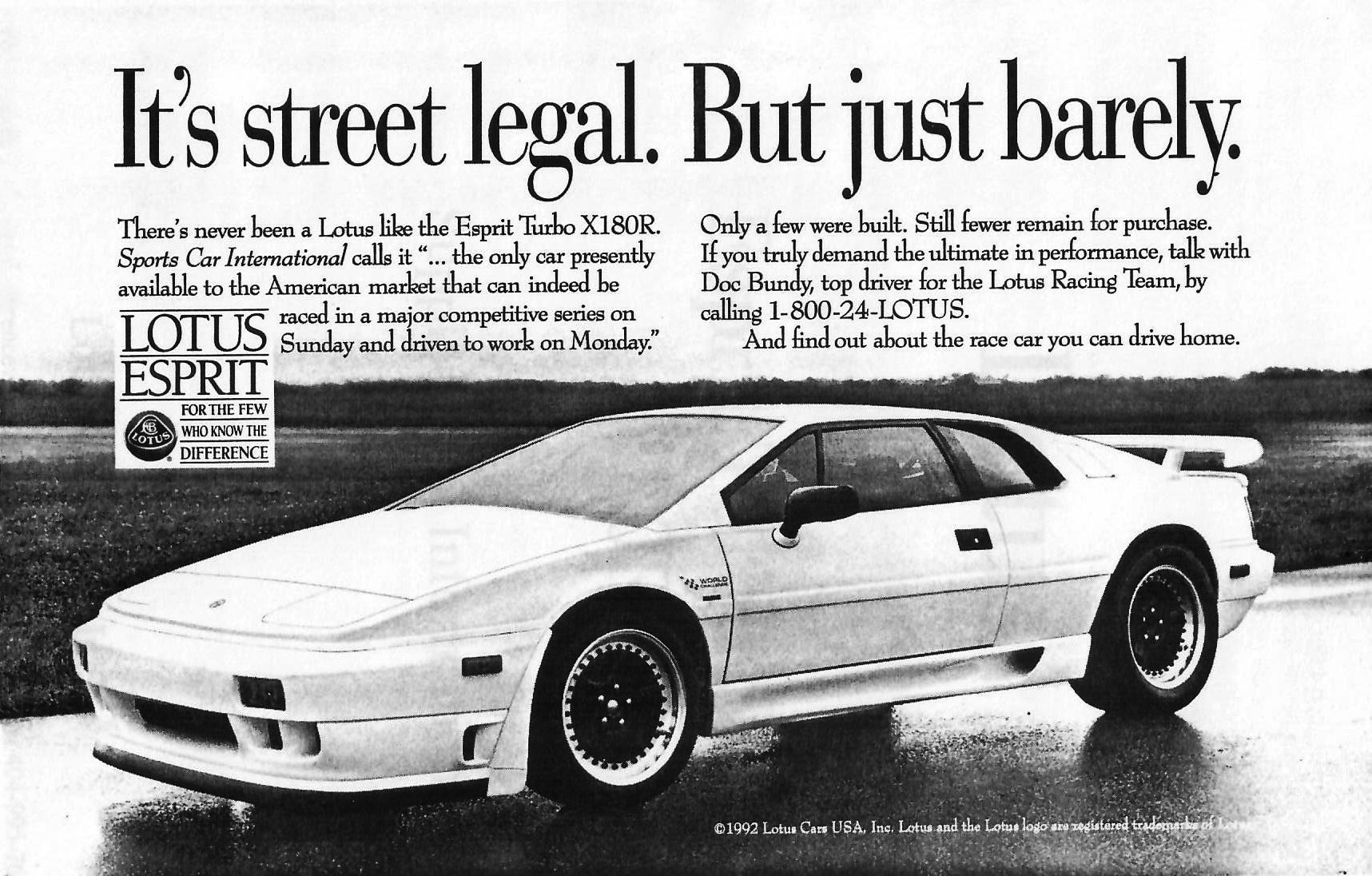
With only twenty road-legal homologation cars produced, plus five fully prepared race cars, the X180R was unlike any Esprit model ever produced. Rolling out of the Lotus’s factory was a highly-developed race car for the road including a full chassis-integrated roll cage, fully adjustable racing suspension, blueprinted engine, deleted and specialized parts for significant weight savings, and a host of other competition upgrades. For the last 30 years, Lotus’s X180R has been the only factory race car with full roll cage, from any marque, sold in the United States that could legally be licensed for the street when new, other than the 1995 model year Ferrari 355 Challenge (technically a conversion from a street coupe to race car performed by dealers).
Three distinct models: Type 105 World Challenge race car, Type 105 homologation cars, Type 106 IMSA race car.
Origins of the X180R – World Challenge Racing
In 1990, the SCCA opened up the previously single-marque Corvette Challenge to other cars, renaming the series World Challenge. This new professional racing series was designed for production-based sports cars with a limited set of modifications for racing. Looking at this as an opportunity, racing driver Doc Bundy pitched the idea to Lotus as a way to better promote Lotus’s high-performance cars in North America and showcase the Esprit’s performance against its peers. David Murry, one of the LotuSport team drivers, recalled “Doc was on the Corvette GTP team with Hendrick Motorsports, and they had a Lotus active suspension on that car. When that whole program went away, Doc went to Lotus in England and said you guys need to showcase your actual street cars in a race series.” Lotus Cars Ltd and its North American branch Lotus Cars USA agreed, though considered it a risky move as a failed attempt might hurt sales. Thus serious development of the Esprit by Lotus factory enginers was crucial to ensure this would not happen.
Lotus, a company founded on Colin Chapman’s racing, quickly formed a plan that pulled two Esprit SEs off the assembly line and sent them to Lotus Engineering for development. Although the Esprit was never designed as a racing car, Lotus quickly focused on developing the platform into something that could achieve success. Internally designated the Type 105, the new racing Esprit model would be substantially lightened and fitted with upgraded components to be competitive. Roger Becker, Lotus development engineer and test driver, commented that the initial planning for the Type 105 specifications took “about a week, but we had a lot of parts in place from our lightweight programme and our office [did] know an awful lot about the Esprit chassis.”
The team was able to drop the stock Turbo SE’s 2,907 lbs weight down to approximately 2,500 lbs in Type 105 specification, while raising power from 264 hp to 285 hp.
Once the first Type 105 was put together, on-track development work was carried out by former Lotus F1 driver John Miles.
Becker recalled, “We took the air conditioning out, but took advantage of the condensor to plumb up extra direct-feed capacity for the standard chargecooling. This allowed us transient horsepower readings in the region of 300 bhp and the motor proved absolutely reliable at 7,000 rpm. The only engine trouble we ever had followed accident damage and loss of lubricant.”
Lotus founder Colin Chapman was famous for focusing on making his cars lighter, as his mantra was “adding power makes you faster on the straights, subtracting weight makes you faster everywhere.”. This applied directly to the Type 105 project, with removal of anything not essential for racing: side glass, third brake lights, electric window assemblies, heater/air conditioner, and interior trim.
The Type 105 race car was developed from the Esprit with the following changes:
Lotus Excel type front spoiler
glass sunroof replaced with fixed panel
plexiglass side windows
removed all interior trim, sound deadening, AC/heating, spare wheel
original wire loom replaced with simpler loom
chassis was not galvanized (unlike road cars), which saved 30 lbs
thinner fiberglass panels (doors, roof, bonnet and engine decklid)
balanced and blueprinted engine
remove high-pressure fuel pump
larger injectors to increase fuel delivery
re-programmed ECM
external pump and transmission oil cooler added in the rear valence
all emissions system removed (required to keep exhaust diameter and routing)
open pipe exhaust replaced the cat/muffler
6-point roll cage, connected near the four shock absorber mounting points and to the frame behind the seats
car lowered 20 mm
limited-slip differential
stiffer springs (50% front, 25% rear)
specially-tuned Monroe shocks
stiffer bushings
Revolution 3-piece wheels (8½ × 16 front; 9½ × 16 rear)
Goodyear Eagle “S” tires (225/50ZR16 front, 255/50ZR16 rear)
braking system replaced with AP Racing 13" (front) and 12" (rear) discs from the Lotus Carlton
4-piston alloy calipers
extra brake cooling ducts
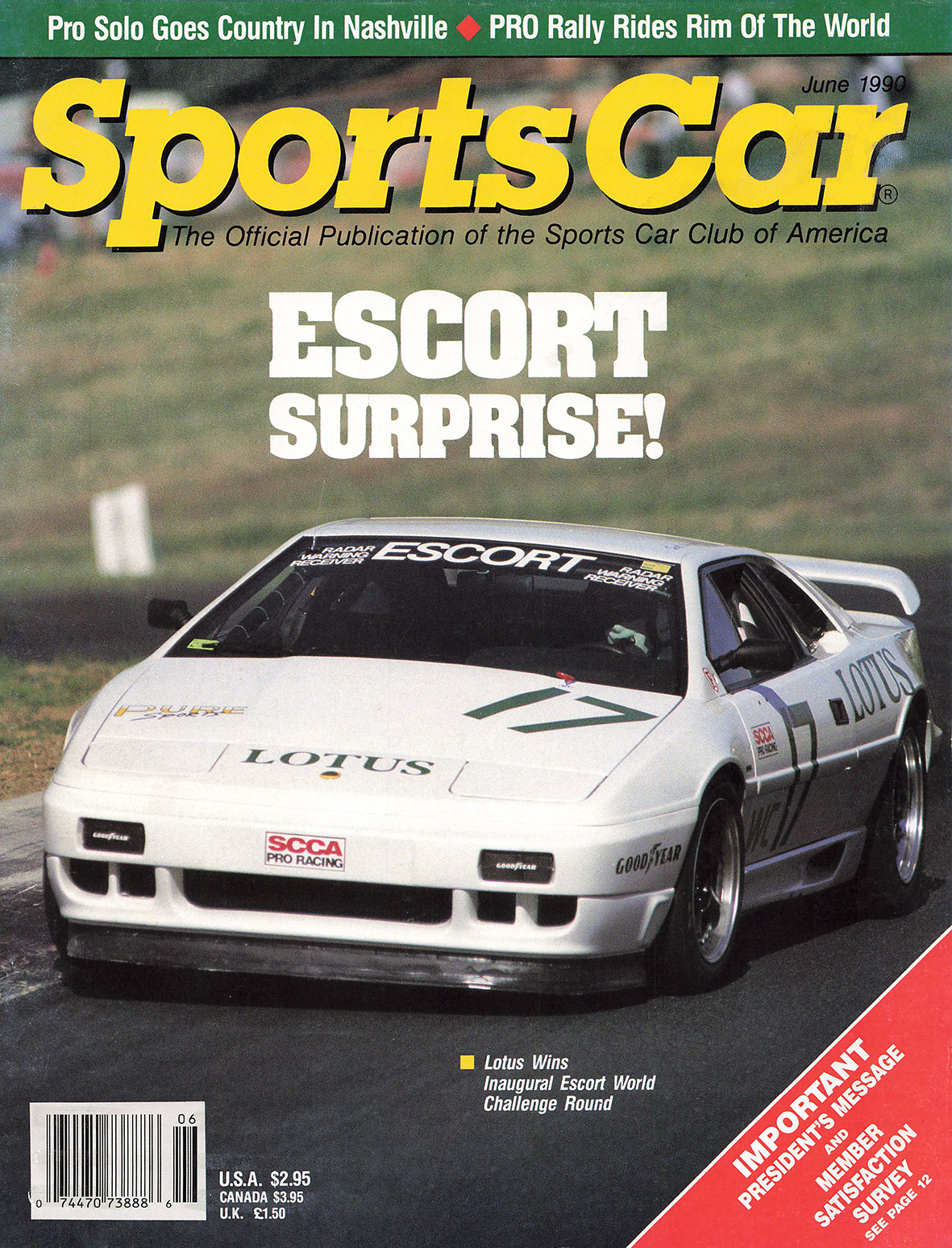
The Type 105 Esprit quickly proved successful, surprising the competitors enough to appear on the cover of the SCCA magazine.
Lotus additionally used the World Challenge series as a test bed for the Esprit’s upcoming ABS system. At the Laguna Seca race, one of the Type 105s was fitted with the new Lotus-designed three channel ABS system, while the other Type 105 retained the non-ABS system. The Esprit fitted with ABS outperformed the non-ABS car, and from Road Atlanta onwards both cars were fitted with the new ABS system.
SCCA used a weight handicapping system for World Challenge, hence the minimum weight of the Lotus raised higher after successive wins.
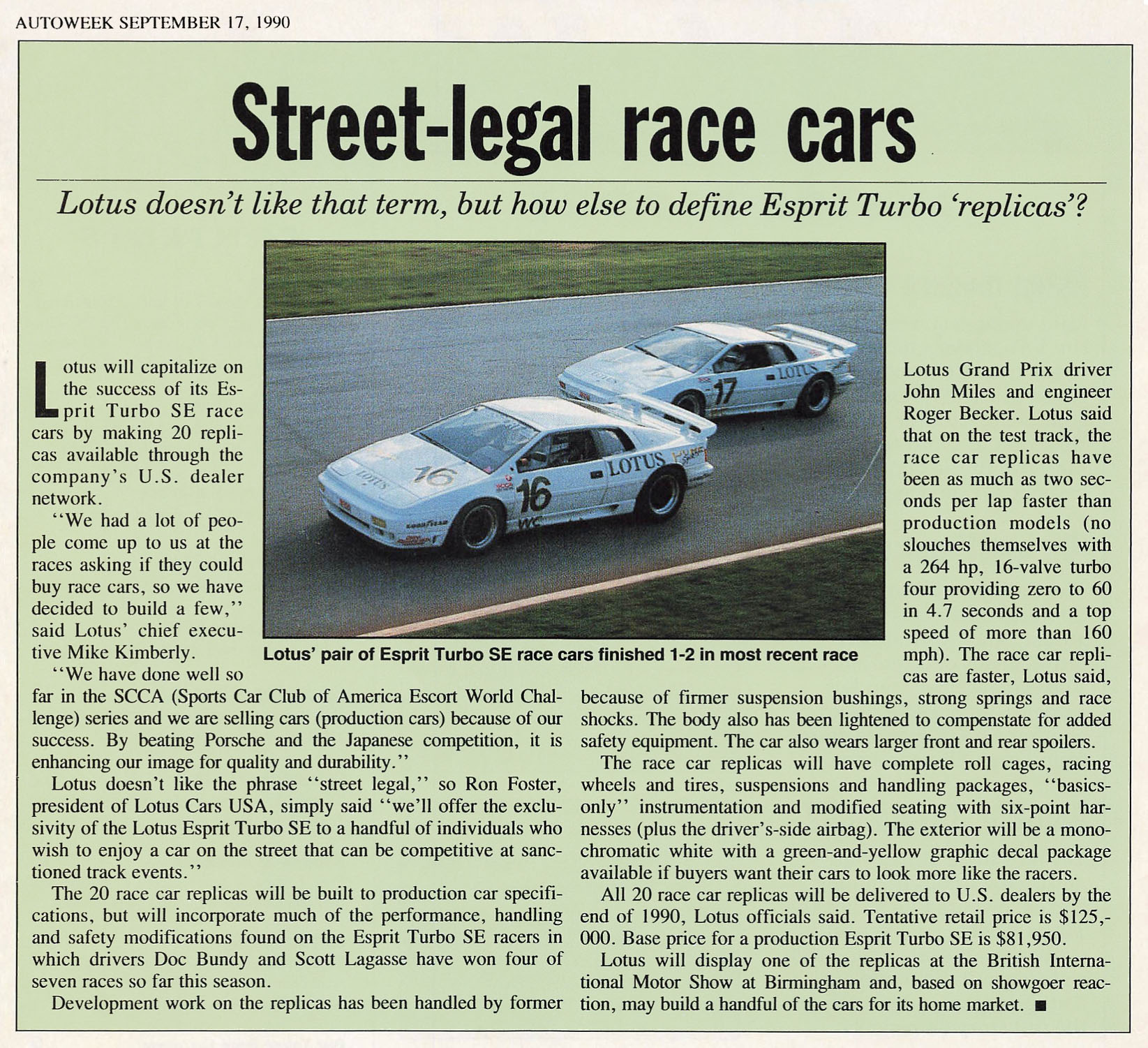
Immediately competitive, the duo of Doc Bundy and Scott Lagasse managed 6 poles and won 4 of 8 World Challenge races that season. Unfortunately, a late season crash stole Bundy’s opportunity to clinch the series championship. To celebrate its US racing success—and to homologate aerodynamic parts for the 1991 racing season—Lotus decided to produce a handful of road-going Esprits nearly identical to the race cars, adding only minimal comforts such as sport seats, glass windows, heat/AC, radio, and a galvanized chassis. Another season passed until Bundy was able win the championship in 1992, thus crowning the X180R as the last Lotus racing model to ever take a major racing championship.
For World Challenge race specification, the Type 105 modifications to the Turbo SE include:
- wheel width can change (diameter must remain the same) … 3 feet long exhaust on the Type 105
- minor suspension tweaking was allowed
World Challenge manufacturers may add any parts to the car, as long as they have an official manufacturer part number. For Lotus this included the front spoilter lip extension. And the much larger 2.9 in (328 mm) disc brakes from the Lotus Carlton/Omega four door sedan.
The rules allow for use of future production options, in this case the ABS braking system developed by Lotus for Delco Moraine to be introduced for the 1991 Esprit SE.
Type 105 Success Leads to the Supercar Series
With great success out of the box during the 1990 World Challenge racing season, the stage was set for Lotus to continue racing in North America. As luck would have it, a new series for high-performance production sports cars was being developed by the International Motor Sports Association of America (IMSA). However, the Type 105 Esprit race cars could not meet IMSA’s homologation requirements, since the car was too far developed beyond any Esprit equipment that Lotus offered to the public.
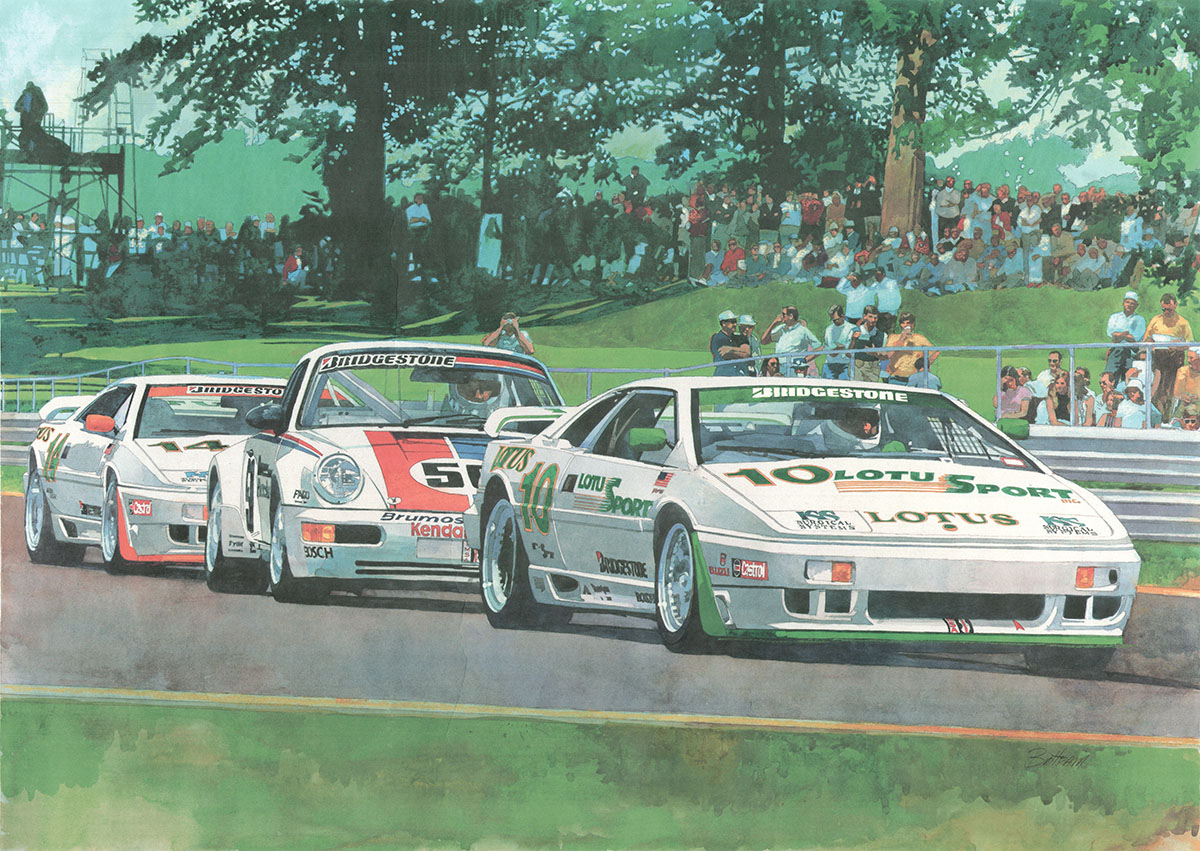
IMSA’s Competition Rules rules required manufacturers to have produced a minimum of 200 nearly identical road cars to the United States in order to campaign a race car, which the existing Steven’s Esprit production had already surpassed over the previous years. However, the homologation rules further required that the manufacturer further produce a minimum of 20 cars which shared the critical components of the “production” race car. Jack Ansley, "[The] IMSA series tried to do the best it could at keeping the cars relatively stock, but these were X180-R Esprits, a race-built version of the Esprit SE. Lotus produced 20 of them and sold them as street cars, the number needed in order that they’d be legal to race in the Bridgestone Series." Lotus scrambled to quickly produce a short run of just enough X180Rs to satisfy homologation requirements to race the Esprit in IMSA’s inaugaral Bridgestone Potenza Supercar Championship for the 1991 season.
Marketing
How would they sell such a specialized and unique Esprit. Would buyers even be interested in such a departure from a luxury high-performance sportscar that the Esprit represented? Why build exactly twenty? Why only available in North America? And why produce a run of cars all at once instead of testing the waters with customers actually ordering cars ahead of time? These are all important details as to why the X180R was actually built. Celebrating its World Challenge success the prior year was only part of the guise.
Lotus actually had an urgent need to produce these cars, and quickly, since the homologation deadline for preparing a car for the new IMSA Supercar series was looming. While apparently lax for the first half season, IMSA homologation requirements dictated that at least 20 cars nearly identical to any entered race car had to be manufactured for the North American market by December 31st of the year prior to the first racing season a car was campaigned. Otherwise, the car would be ineligible for competition until the following season. As part of the Bridgestone Supercar Championship requirements, at least twenty of the homologation cars were required to be road legal in North America. Lotus wasn’t the only manufacturer to build exactly 20 cars for this homologation process…Porsche followed suite, building exactly 20 of the 911 Turbo S2 to homologate the car that Hurley Haywood would go on to win the IMSA Bridgestone Supercar Champsionship in 1991 and 1993. While Lotus erred on the side of building the most complete replica of the race car that could legitimiately be road registered, Porsche took a different approach by offering a more street focused base model S2 without any roll cage and racing harnesses. Even further, Porsche partnered with ANDIAL, effectively the Porsche Motorsports arm in the US at the time, to import the cars without the upgraded engine and turbocharger as they did not quite comply with EPA regulations at the time. Instead, the importer ANDIAL would swap out on all twenty cars with an already homologated Porsche engine upgrade package once they had cleared all the regulatory import hurdles, and before the cars were distributed to dealerships.
But how to sell such a departure to North American customers who were used to the Esprit being a high-performance luxury sportscar? Well, coming off a successful racing success with the Type 105, marketing a had an ingenious idea to explain the racing replica car to protential buyers: name the X180R the World Challenge edition.
Several options were originally specified by Winterbottom for the X180R, which were removed prior to the series of X180Rs being assembled. These included racing seat belts (which the NHTSA would not have approved for use in the US) and an oil pan baffle.
Highlights from IMSA’s Supercar series from the 1994 IMSA Code Racing Regulations:
“designed to encourage race competition of street legal exotic sports cars, to demonstrate the relative speed and excitement created by these makes”
“produced at a rate of at least 200 units in a 12-month period, described and published in manufacturer’s catalogs, marketed in the U.S. and available for purchase through the manufacturer’s dealer organizations, and bearing the manufacturer’s serial numbers designed for the eligible model year.” “Model variants introduced after the first race of the season will not be approved until next season.”
“entrants are required to have in their possession at each event the official factory shop manual for the make and model of their car(s) in order to verify standard components and configurations.”
“Each car must conform stritly to its standard configuration as delivered to U.S. buyers by the manufacturer except where these rules allow or require specific modifications.”
“Roll Cage - Must be a welded cage” … “The roll cage must be fabricated from seamless mild steel tubing, bolted or welded to the chassis.”
“air conditioning components and associated parts” may be removed
This allowed manufacturers to sell a car without a roll cage, fuel sell, safety harness, safety window net, and fire extinguisher. However, shock absorbers must be the same, though can be swapped as long as “interchangeable with the originals without any modifications”. Wheels must be “as delievered”, however by the 1992 season the Lotus team was allowed to run 17" rear wheels.
Lotus Esprit X180R mandatory tire sizes in 1994: 225/50-16, (275/40-17??), minimum weight of 2,800 lbs for 1994 vs the Porsche Turbo S2 at 3,200 lbs.
30-minute televised race as part of the full IMSA weekend
For 1991, each Bridgestone Supercar Championship supported a prestige Camel GT championship race. Total prize fund was significant, at $375,000.
Each sports car was minimum weight, adjusted over time Engines must remain standard, though IMSA allows blueprinting the engine
Unlike other production car series, IMSA allowed removable of catalytic convertors and running straight pipes, which ensured spectators enjoyed mechanical symphony of the engines.
Development of the X180R Homologation Car
IMSA racing regulations for Bridgestone Supercar specifically stated that “model variants introduced after the first race of the season will not be approved until next season”, technically Lotus had until the first Lime Rock race in May 27, 1991 to introduce the car. Development was well underway by October 1990, with the homologation car internally dubbed at Lotus the “World Challenge Race Car Replica”. Oliver Winterbottom, Lotus Designer, managed the X180R project with engineer Dave Minter responsible for all the technical details to build the car.
While a six month lead time to meet IMSA’s requirements was reasonable, the real pressure cooker for Lotus Engineering was a new tax law in the United States that potentially jeopardized the entire racing program. IMSA required that all twenty of the homologation cars were to be sold in the North American market and a new United States 10% luxury car tax would become effective on January 1, 1991. Winterbottom commented in his book, “The [X180R] prototype was finished in late October 1990, and all the cars needed to be landed in the USA before the end of the year, to avoid the forthcoming luxury tax. We just managed it.” Had the X180R project been delayed even by a few weeks, the cost of purchasing an X180R would have increased by approximately $12,800, possibly killing any viability of selling a homologation race car and along with it any chance to race competitively in IMSA’s Supercar series.
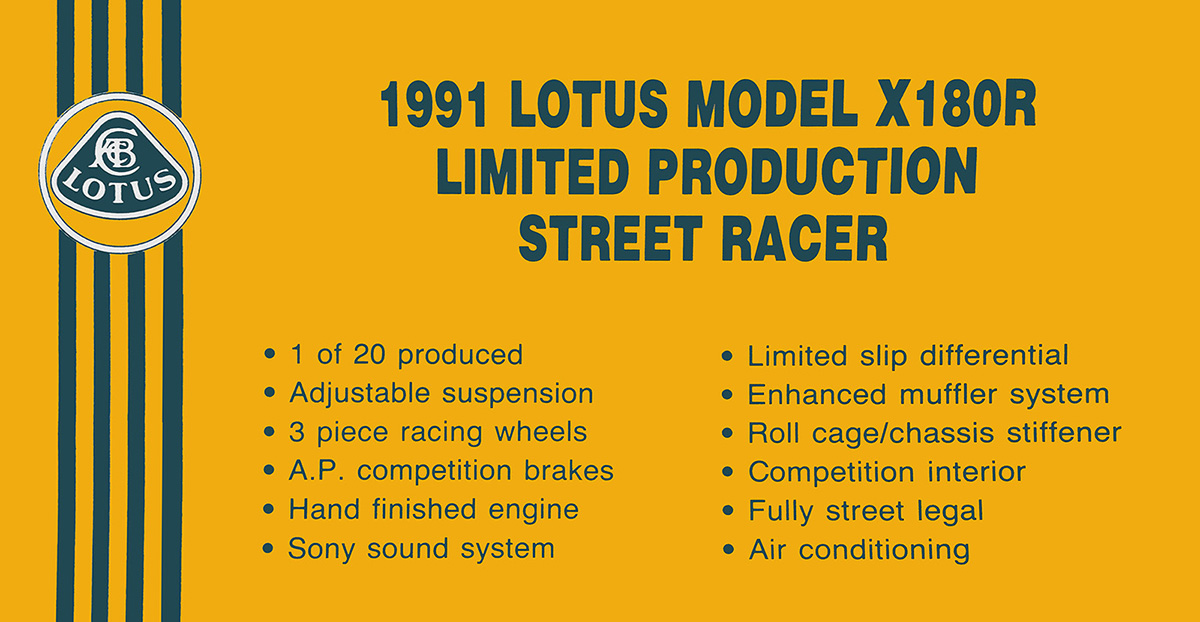
From the X180R Owner’s Handbook Supplement: “This special edition model has been designed as a fully road going ‘replica’ of the successful Lotus Esprit SCCA racing car, with certain changes made in order to comply with emissions regulations and other legal requirements.”
Fitted with a steel roll cage, the X180R had 20% added torsional stiffness than an Esprit SE, while still shaving approximately 300 lbs from the SE weight. Aerodynamic changes included a different rear wing mounted further back, front spoiler, flared fenders. The X180R maintained the race car feel with a nomex-like “doeskin” interior material, though added a federally mandatory air bag steering wheel. Through oversized fuel injectors, reprogrammed ECU, redesigned exhaust system, and increased boost to 1 bar (14.5psi), the X180R’s Type 910S 4-cylinder engine added 46 hp over the base Esprit model, yielding 286 hp. Additional mechanical upgrades included beefier suspension, ZF clutch-type LSD, modified brakes, fog lights removed for brake cooling ducts, and larger 16” aluminum 3-piece Revolution wheels.
All of this development translated into a 0-60 mph in 4.6 seconds, 0-100 mph in under 12 seconds, and a 170 mph top speed. While today the X180R is considered the holy grail of Esprit models, its MSRP in 1991 of $126,000 scared many potential buyers away, with the X180R tending to sit in dealerships awaiting a lucky new owner who understood how special it was.
The X180R homologation car featured additional items that never appeared on the Type 105 World Challenge race cars, like the flared front fenders.
Type 106 — The IMSA Supercar
While the Type 105 campaigned with great sucess in SCCA Pro World Challenge, significant improvmenets would need to be be undertaken to be competitive against the other factory backed teams like the Jacksonville, Florida based Brumos Porsche team.
The iconic multi-color neon colored decals on the mirrors, windshield stripe and rear wing were a 1991 mid-season addition by Doc Bundy to make the cars easier to identify on track.
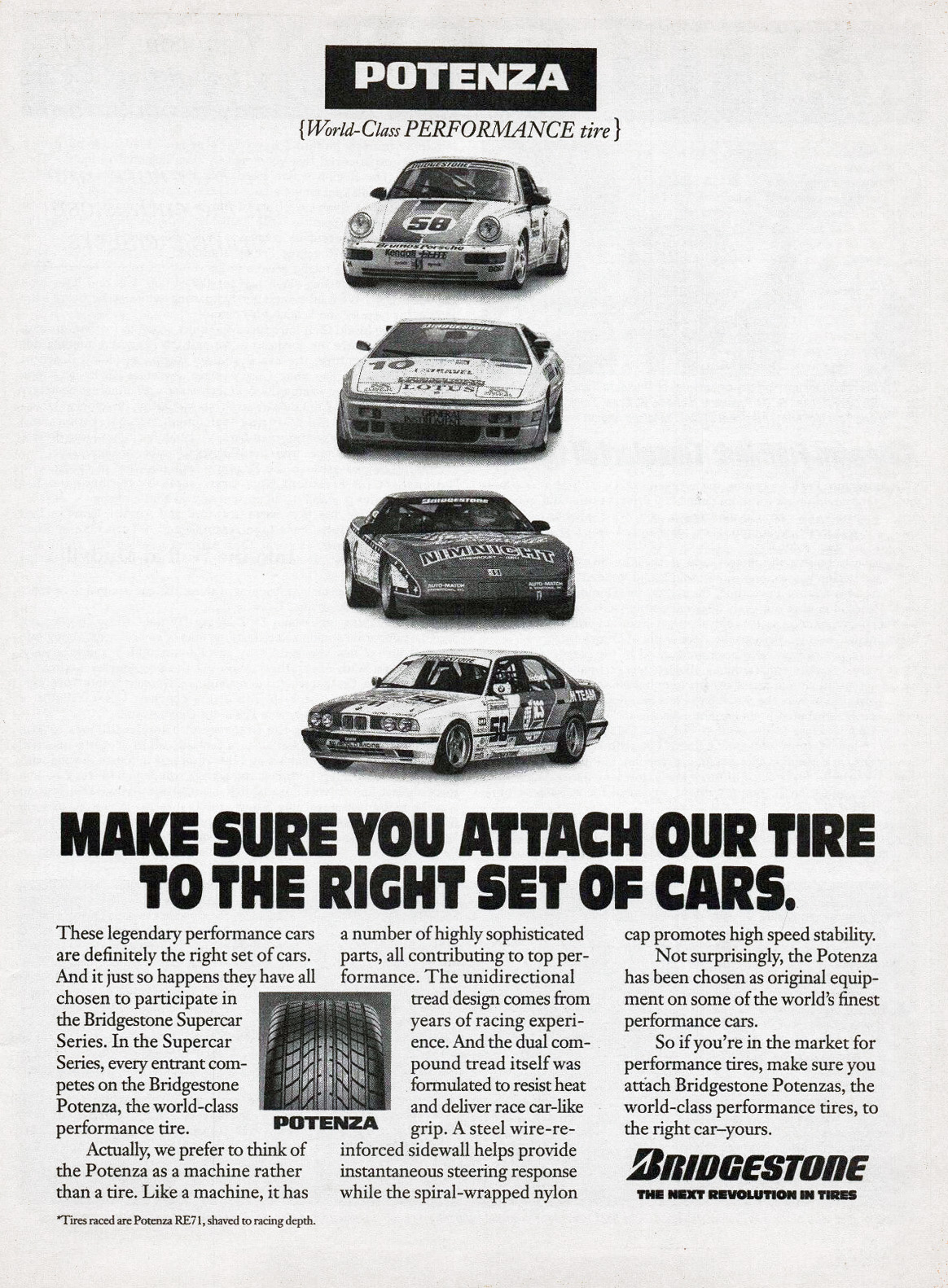
Jack Ansley, "[The X180R had] an advertised 285hp to start with from the factory. Remember, though, we were looking at being competitive with Porsche, which was running the 911 Turbo. We were limited under the rules to stock boost pressure, but we still managed to routinely get 450hp out of the engines. I think the most we ever got in a dyno test was around 525hp, just trying to see what it could take. That’s from a 2.2-liter four that was rated at 160hp before it was turbocharged. Race days, we were generally running 450 to 475hp, in a car that we got into the 1,900s, weight-wise."
“1992 model X180Rs” per Ansley Turbocharger for the “1992 model X180R” was 525.4021.603AF (different than the 1991)
While some enthusiasts immediately snatched up a rare opportunity to own a race care for the street, many X180Rs sat in dealerships for months or more than a year before selling.
Competition Follows Suit
Porsche followed suite, producing exactly twenty 964 Turbo S2s explicitly to homologate the car for the same Bridgestone Supercar Championship that Lotus entered the X180R. Unlike the stripped down and race-ready Lotus X180R, Porsche did not push the envelope as far with the 964 Turbo S2 homologation specials with the cars beind sold to customers without a factory roll cage, racing seat belts, or spartan interior. Porsche still had painful memories of lengthy battles with the DOT and EPA over its attempt to import the 959 Sport (959S) under a non-road going race car exemption. The US was a critical market for Porsche’s financial success, and being denied import of a supercar they had heavily invested in was a painful lesson. Thus Porsche was wary of trying to bring in a modified production road-going car, especially since homologation required the vehicles be licensable for street use.
Not to be thwarted from a chance at racing Porsches in a major televised series, Porsche racing driver Hans Stuck and Alwin Springer, then president of Porsche Motorsports North America and owner of the famous ANDIAL tuner, hatched a plan with Porsche. Porsche would build and export twenty as well optioned USA-spec 964 Turbo homologation specials directly to ANDIAL. The 964 Turbo S2 left Porsche’s Stuttgart factory with minimal engine preparation, as the Type M30/69 3.3L turbo-charged racing engine would not pass EPA import requirements. Once the 2,822 lb homologation cars arrived at ANDIAL they would install an already homologated “retrofit” power kit provided by Porsche, before being distributed to dealers. By the time the 964 Turbo S2 reached customers at 18 dealerships in the United States, and two in Canada, the added power kit increased the base sticker price by $10,065 USD to $119,005, before any other options.
While technically legal by IMSA’s own rule book, as the Monroney window sticker for the 964 Turbo S2 included a “S2” notation, this was pushing the boundaries. The conversion included different turbocharger, intercooler, camshafts, cylinder head gasket, along with adjusting valve lifts, clearances, and timing. Porsche was allowed to compete with the S2, taking the championship after winning four of the seven races during 1991, with Lotus taking home one win since they only ran the last three races of the season. However, the irony is thick, as IMSA and Porsche later protested that David Murry’s Lotus X180R had a swapped turbocharger after his 1993 Lime Rock race win.
“All 20 cars had been fully optioned at the factory in nearly identical form to the race version excluding suspension, full race prep differences and the ‘S2’ engine upgrade which was to be fitted by ANDIAL.”
(Did Porsche have to sell 20 in NA? That would make sense as the 1991 964 RS N-GT would have made more sense…except it was not available in US, though 290 were produced).
(did they have to have been sold in the North American market? THat would explain why they were only for the US/Canada…like the Porsche Turbo S2!) X180R homologation specials.
shaved-down Potenzas
Sport 300 – X180R’s Successor for European Lotus Enthusiasts
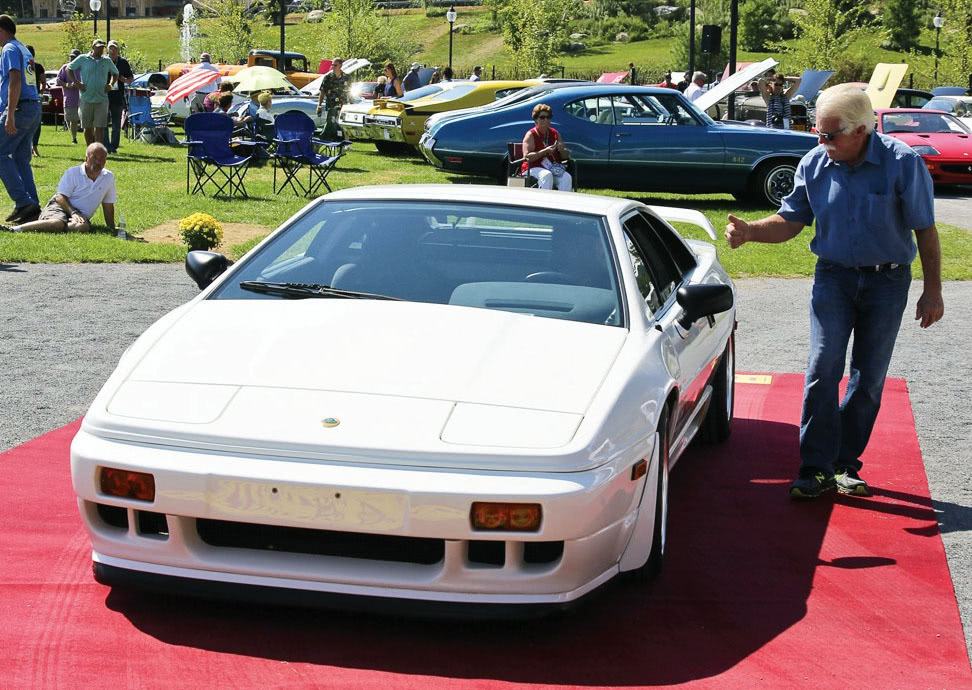
The North American only X180R ultimately led to the development of the Esprit Sport 300 for the European market in 1993. So named for the 300+ horsepower the Sport 300’s four-cylinder 910S produced when the Garrett turbocharger was on full boost. While similar to the X180R, its base trim was geared more to be a high performance track car specification. The Sport 300 chassis was not as stiff as teh X180R, as it lacked the full roll cage mated directly to the chassis, the 300’s rigidity was significantly more than a standard Esprit thanks to its four-point braced frame. The optional LotusSport competition package took the car close to the original X180R racing roots, including adding a full bolt-in roll cage, racing seat belts, and a fire extinguisher. Capable of 0-60 mph in 4.7 seconds, and 0-100 mph in 11.7 seconds, the performance was not quite on par with the X180R. Having achieved great racing success in America, Lotus decided to campaign Esprits at Le Mans. They turned to the Sport 300 as the basis for development, entering a pair of Sport 300 Turbos in 1993 and 1994. Unfortunately in both years, success evaded Lotus due to overheating issues from insufficient cooling when cars were brought in fordriver and tire changes. Lotus ultimately produced 64 Sport 300s over the two year production period.
Personalities
- Roger Becker, Lotus development engineer for the Type 105 race car
- Oliver Winterbottom, Lotus manager for the X180R road-going project
- Dave Minter, Lotus chief engineer for the X180R
- Alan Nobbs, Lotus powertrain engineer for racing team (hired from Corvette ZR-1 project)
- John Miles, Lotus chassis development (former Lotus F1 driver)
- Colin Marriott, Lotus engineer helping with chassis, engine, etc
- Richard Clarke, Lotus Cars USA field engineer (previously worked for Lotus Engineering in active F1 suspensions)
- Doc Bundy, LotuSport top driver (1990-1995)
- Scott Lagasse, LotuSport driver
- Andy Pilgrim, LotuSport driver
- Paul Newman, LotuSport driver
Stats
Engine
- Power: ??? hp @ 6,500 rpm
- Torque: ??? lbs-ft @ 3,900 rpm
- Redline: 7,000 rpm
- Bore x Stroke: 95.3 x 76.2 mm
- Displacement: 2,174 cc
- Compression: 8.3:1
- Fuel Delivery: Bosch K-Jetronic
- Valve Train: 4-valves/cylinder, belt driven DOHC
Dimensions & Capacities
- Curb Weight: 2,767 lbs
- Weight Distribution: 42% (front) / 58% (rear)
- Wheelbase: 96.0"
- Track: 60.4" (front) / 61.9" (rear)
- Length: 170.5"
- Width: 73.2"
- Height: 44"
- Fuel Capacity: 18.5 gallons
Steering, Suspension & Brakes
- Turns Lock-to-Lock: 3.0
- Turning Circle: 36 ft
- Wheels: Revolution 3-piece Alloys, 8.5 x 16 (front), 9.5 x 16 (rear)
- Tires: 225/45ZR-16 (front), 255/50ZR-16 (rear)
- Brake Discs: 13" ventilated discs
- Brake Calipers: 11" four-piston AP Racing
- Brake Pads: Ferodo 3432 high-performance brake pads
- Gears: 3.36 (1st), 2.05 (2nd), 1.38 (3rd), 1.03 (4th), 0.82 (fifth)
- Final Drive: 3.889
NOTES
- Roger Becker, Lotus development engineer/test driver, always wanted to develop 911 beating lightweight
- Type 105 development as quick, one week?
- John Miles drove in 24 hour race, but otherwise Pure Sports did most development
- Pure Sport was helped by TWR technician Colin Marriott and transmission pioneer Alan Nobbs
- type 105, dry weight 2,400 lbs
- galvnized body saved 17.6 lbs
- FIA approved roll cage in 105, fitted to suspension towers
- 10mm reduced ride height
- Lotus Carlton injectors for race car
STREET CAR
upgraded RAC-approved club roll cage John Miles and Roger Becker helped develop street race car 264 hp? 0-60 4.7 seconds?
TYPE 106 notes
more complex FIA roll cage 17" heels on rear (in IMSA spec or WC)
| Esprit SE (SCCA Race Car) | X180R (Homologation Street Car) | X180R (IMSA Spec Race Car) | |
|---|---|---|---|
| Type | 105 | 105 | 106 |
| Model Year | 1990 | 1991 | 1991+ |
| Volume | 2 | 20 | 3 (+ 2 converted Type 105 SCCA race cars) |
| Engine | Lotus 910S | 910 S | |
| Engine Capacity | 2174cc | 2174cc | 2174cc |
| Horsepower | 285 hp | ? hp | 300 hp |
| Carb | Lotus/Omega Injectors | ||
| Transmission | Blueprinted by Renault | ||
| Chassis | Ungalvanzied steel backbone, front cross member, tublar engine bay | ||
| Body | Light G.R.P.shellf, FIA roll cage, plastic side & rear windows | ||
| Front Suspension | Uprated and strengtheneed, adjustable revised geometry & lowered | ||
| Rear Suspension | Upgrated, strengthened, provision for rear anti-roll bar and lowered | ||
| Brakes F/R | 12"/13" AP discs & 4piston alloy calipers | 13"/11" AP ventilated discs and 4-piston calipers | |
| Wheels | 16 x 8 1/2 and 16 x 9 1/2 | 16x8 1/2 ; 17 x 10 1/2" Revolution 3piece | |
| Tires | Goodyear Eagle ZR | 245-45x16 + 315-40x17 Goodyear Eagle ZR | |
| Length | 168" | ||
| Width | 75" | ||
| Height | 43" | ||
| Wheelbase | 96" | ||
| Track F/R | 60 1/2" / 62" | ||
| Weight | 2,400 approx. | 2,300 approx. (race weight 2,500 to 2,800 lbs) |