The Esprit X180R became Lotus’s most successful factory-built road racing car since Team Lotus’s domination of the 1978 Formula One World Championship with the Lotus 78 and Lotus 79. Between 1990 and 1995 the car ran two parallel campaigns — the SCCA Escort World Challenge and, from 1991, IMSA’s Bridgestone (Potenza) Supercar Championship — and along the way it took a Drivers’ title, runner-up finishes in the manufacturers’ standings in both its SCCA World Challenge seasons and both full IMSA Supercar seasons, and the reputation for having raced the German factories to a standstill in one of the closest production-based series America has seen.
These were incredible races. I’ve seen a lot of races in my time, and this series was some of the best, most intense, most competitive racing that I’ve ever witnessed, or that anyone has.
Jack AnsleyLotuSport owner · 2009
Looking back at the Bridgestone Supercar series nearly twenty years later, LotuSport owner Jack Ansley recalled a support series stacked with factory talent: “It was a support series with an amazing level of driving talent spread among factory programs from Lotus, Porsche and Chevrolet. And most of these races were only 30 minutes long, with almost every one a flat-out, flag-to-flag sprint.”
The record, race by race
15 wins from 57 races. Each mark is one race, in the order it
was run — hover any mark for the event and the finish.
win podium finished no finish
Sears Point · P1
Dallas · P25
Laguna Seca · P1
Des Moines · P3
Road Atlanta · P1
Mosport Enduro · P8
Denver · P1
St. Petersburg · P6
1990SCCA
Sears Point · P2
Dallas · P4
Des Moines · P3
Denver · P1
Road America · P1
Texas World Speedway · P1
Mexico · no finish
Lime Rock · P13
Watkins Glen · P12
Road Atlanta · P1
Road America · P2
Del Mar · P2
1991IMSA
Miami · P4
Road Atlanta · P1
Lime Rock · P3
Watkins Glen · P3
Laguna Seca · P2
Portland · P1
Phoenix · P1
Del Mar · P2
1992IMSA
Miami · P1
Atlanta · P1
Lime Rock · P5
Watkins Glen · P6
Cleveland · P6
Laguna Seca · P3
Portland · P7
Phoenix · P2
Sebring · P6
Road Atlanta · P1
1993IMSA
Sebring · P6
Long Beach · P8
Lime Rock · P3
Watkins Glen · P2
Laguna Seca · P3
Portland · P3
Phoenix · P1
Sebring · P3
Sebring 12 Hours · P5
12 Hours of Sebring · P12
Road Atlanta 1 hour (GTU) · P13
1994IMSA
Sebring · P7
Long Beach · P10
Lime Rock · P3
IMSA 1 Hour Lime Rock · P18
1995IMSA
1996no record
‘97–‘99did not race
Charlotte · P9
Mosport · P18
Lime Rock · P22
Texas Motor Speedway · P16
2000SVGT
171 car-entries across 57 races; 47 podium finishes and
16 poles. A race may carry more than one X180R, so a podium is counted per car and a
win per race. One drivers’ championship: Doc Bundy, IMSA Bridgestone Supercar,
1992.
1996 is not yet transcribed — the privateer Sprint Challenge
title is missing from the marks above, and the record says so rather than quietly closing over it.
X180R Career Summary (1990-1995)
Across six seasons, the Esprit X180R took one overall Drivers’ Title (the 1992 IMSA Bridgestone Supercar series) and finished runner-up for the Manufacturers’ Championship four times — in both SCCA World Challenge seasons (1990 and 1991) and both full IMSA Bridgestone Supercar seasons (1992 and 1993).
The Paul Newman effect | Any factory-backed team that wins races earns good publicity, but LotuSport had an unusual asset in occasional driver Paul Newman. The connection ran through one of the team’s regulars: according to Ansley, Michael Brockman “was good friends with Paul Newman, was kind of my source to get Paul onto our team…Mike commonly used the American flag windshield tint on his Lotus, to distinguish him from our other drivers.”
Doc Bundy won the 1992 IMSA Bridgestone Supercar Driver's Championship with the Lotus Esprit X180R.
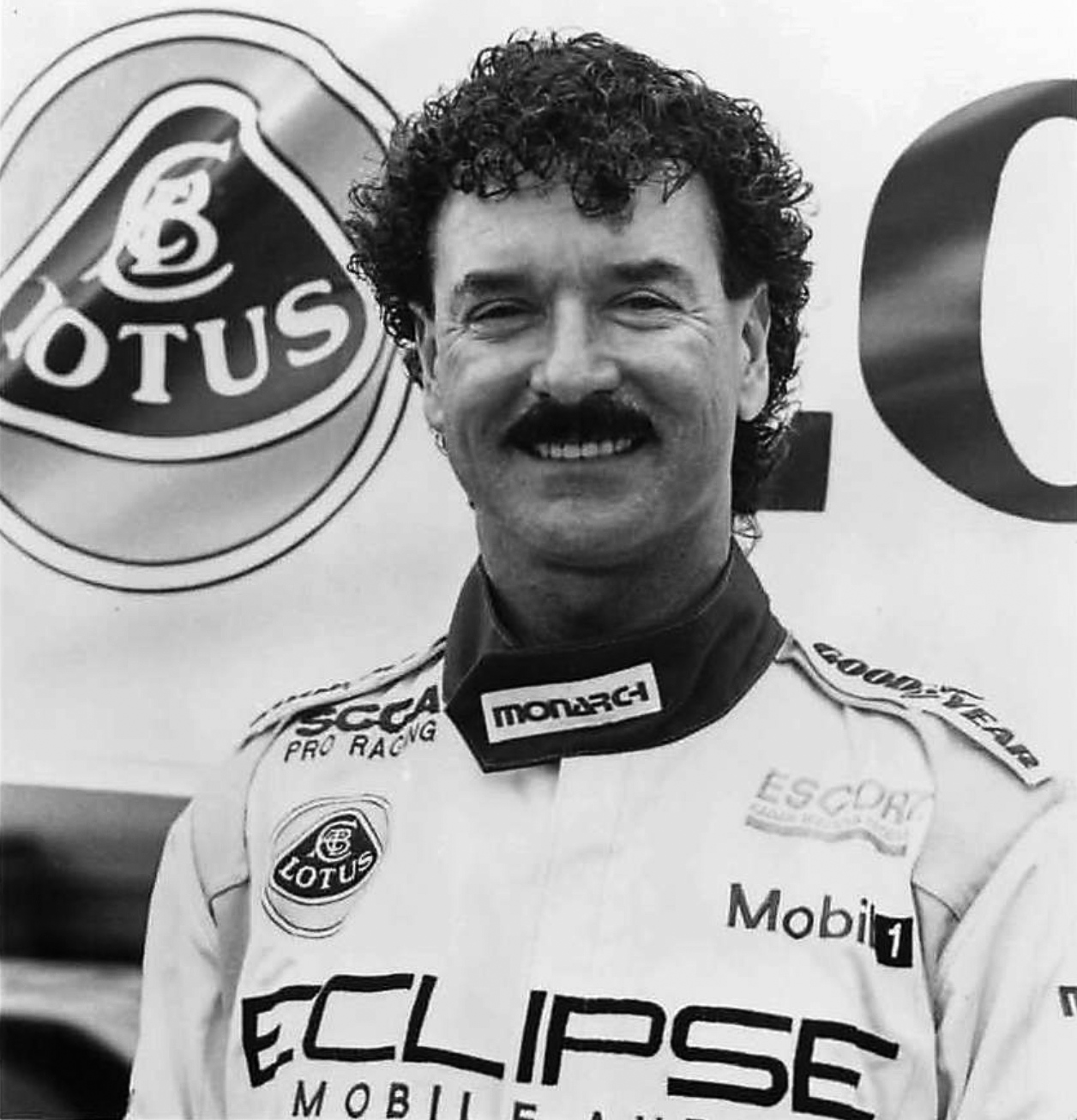
The 1992 high-water mark | The program’s peak came in 1992, when Doc Bundy won the IMSA Bridgestone Supercar Drivers’ Championship in one of the LotuSport team’s five X180Rs — the last major racing title Lotus would win. Lotus did not, as long claimed, also take the Manufacturers’ championship that year; the 1992 season page sets out the evidence. It was Bundy who had first pitched Lotus on entering the Bridgestone Supercar series, and Lotus took the plunge.
Manufacturers were drawn to the series for hard commercial reasons: the races ran in support of the heavily attended IMSA GTP events, sponsorship packages were strong, and — decisively for the era — the races would be televised.
The cars that Bundy, Newman, Andy Pilgrim, and the others raced were remarkably close to what a customer could drive off the showroom floor, and arguably more raceworthy than earlier homologation specials such as the Dodge Charger Daytona and Plymouth Superbird. Lotus wanted a share of the high-dollar sports-car market in which Porsche was so heavily entrenched; racing the German cars head-to-head, and being genuinely competitive against them, did the marque’s reputation no harm at all.
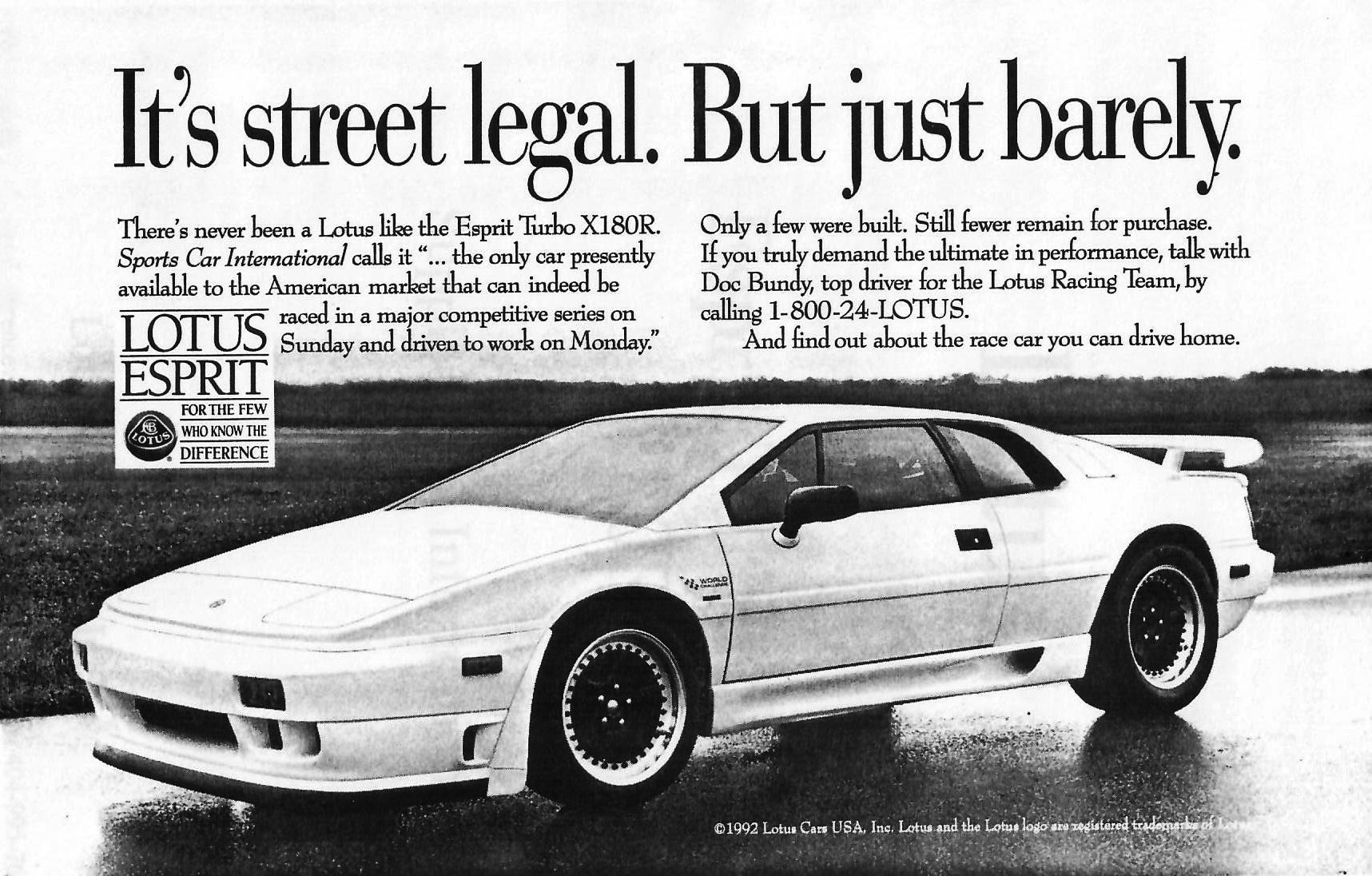
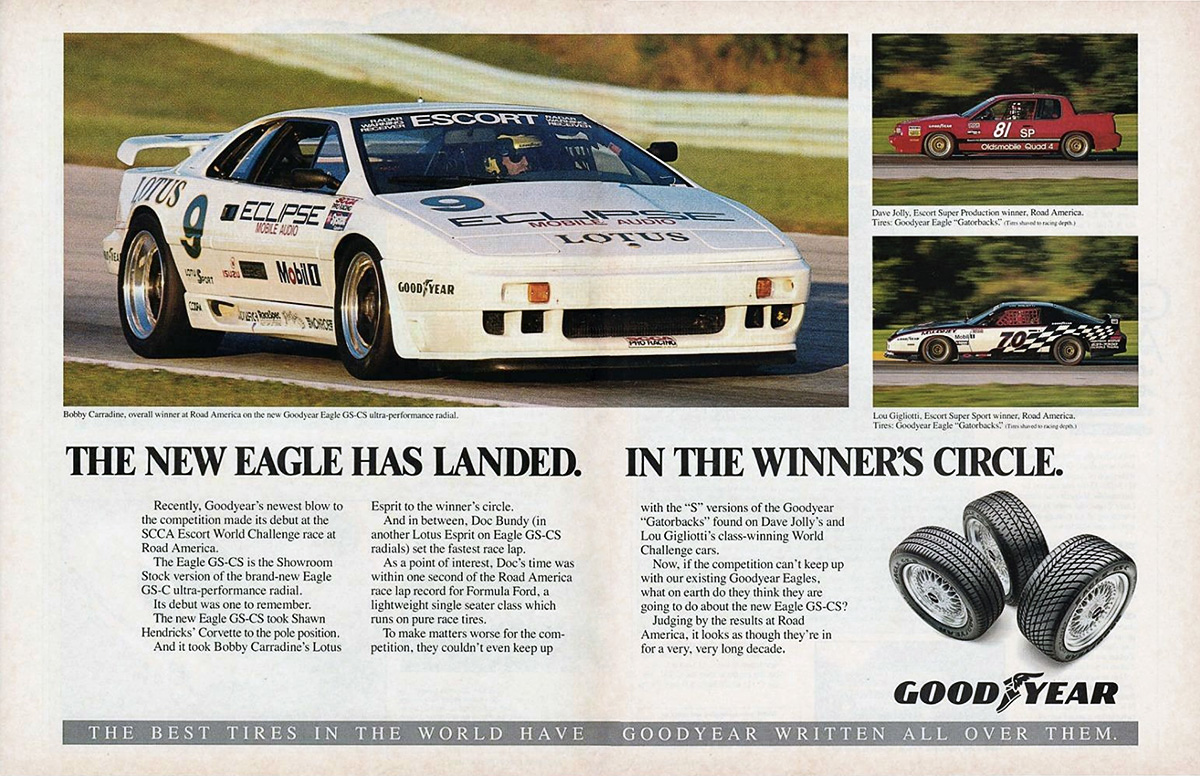
Lotus Cars USA advertising built around the X180R's street-legal homologation, pointing customers to Doc Bundy — "top driver for the Lotus Racing Team."Goodyear ad touting the X180R's wins and fastest laps in the 1990 SCCA World Challenge to promote its Eagle GS tires.
The car numbers | After all these years, some confusion about the cars’ numbers remains. The team generally ran numbers 9 through 12. Doc Bundy did not always drive the same chassis, but whichever car he raced carried the number 10, while Michael Brockman ran either 11 or 12 — LotuSport reassigned cars among its lead drivers to work around IMSA’s per-chassis weight penalties.
To keep the field close, IMSA raised the X180R’s minimum weight each year as the car grew faster:
The more highly developed Type 106 X180Rs were sold without a 17-digit VIN, ensuring they could not be registered for the road in North America. The first Type 106 (VIN SCC 52591001 / engine LP 9108 9022259440) was re-imported from Lotus Ltd to LotuSport for a customs value of $154,000 on March 30, 1993, after being on loan from Lotus Cars USA for display in Europe. Its engine, LP 91089022259440, was built in August 1991 — two months before the engines for the road-going X180R.
Post IMSA
When LotuSport withdrew from the Bridgestone Supercar series, the surviving race cars sat until they were sold off. Two went to Steve Hansen, a LotuSport sponsor and driver, one of them car No. 12; one went to Kyle Kaulback in Pennsylvania; and two were sold by Lotus to Bruce Morton, of Move-It Motorsports in Arizona. Morton planned to campaign them in the 2000 Speedvision GT World Challenge series with Elliott Forbes-Robinson and Butch Leitzinger driving, and leased Hansen’s No. 12 to make up a three-car entry. The team could not secure sufficient funding, however, and contested only a handful of races that season, bringing the Lotus X180R’s professional racing history to a close. Which chassis went where is only partly established; the evidence is set out in Aftermath.
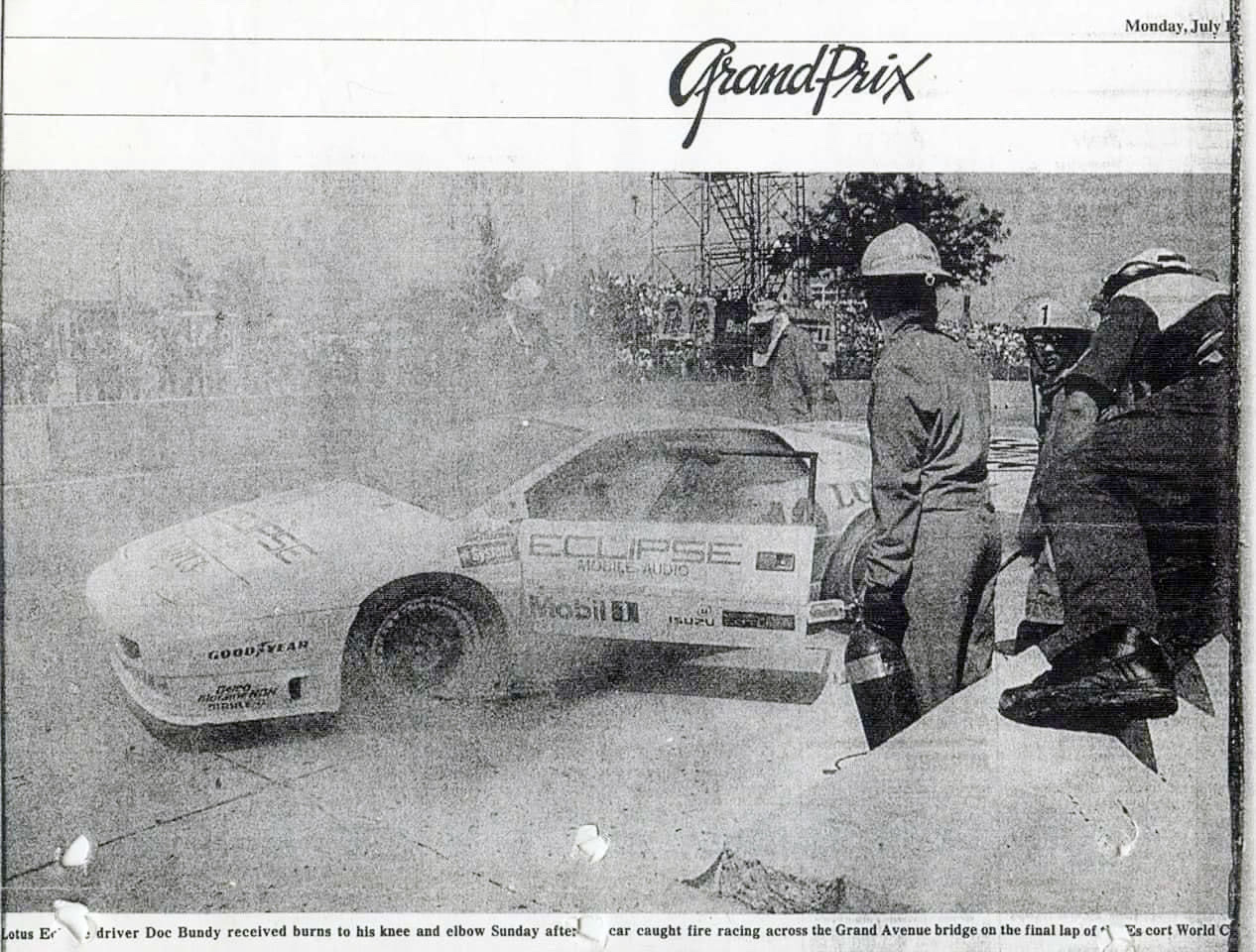
Doc Bundy received burns to his knee and elbow after his car caught fire racing across the Grand Avenue Bridge during the final lap of the 1990 Escort World Challenge race. The fire started after an oil cooler line was damaged, spraying oil onto the hot exhaust/turbo. Joe Grassi reached into the flames to pull Bundy from the car, who ended up with only minor burns. (Credit: Des Moines Register – July 16, 1990)
The weight IMSA made it carry
The car won, so the rulebook made it heavier. Sourced minimum weights only — a dashed
track means no figure survives.
1990SCCA
1991IMSA
25751992IMSA
27001993IMSA
28001994IMSA
1995IMSA
1996no record
‘97–‘99did not race
2000SVGT
IMSA Bridgestone Supercar only. 1990 stands above empty ground because no IMSA rulebook
existed for it — that season ran to the SCCA’s rules, which is a fact, not a gap, and
its weights are not comparable. The same thing happened there, faster: the minimum opened at
2,500 lb and was raised to 2,650during the season, because the car kept
winning.