Sears Point
May 5, 1990- P1Doc Bundy/Scott Lagasse #17Grid 5thVIN SCCFC20851HF65798 led 83 of the 92 laps (laps 7-49 and 53-92)
Escort World Challenge debut — four wins and runner-up in the Manufacturers' Championship.
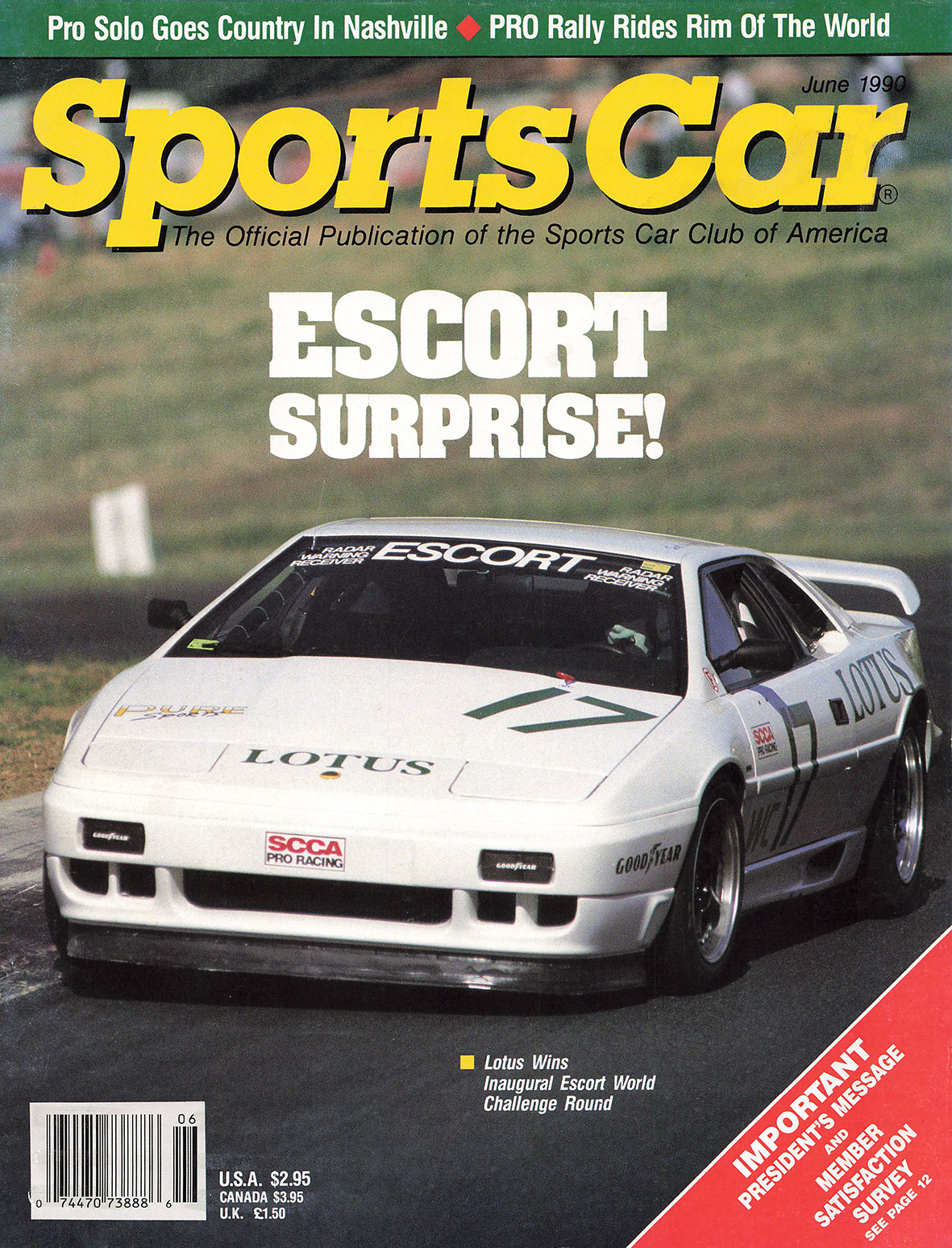
The 1990 SCCA Escort World Challenge marked Lotus’s return to American road racing after a twenty-five-year absence, and the marque announced itself at once. Fielding two Esprit SE-derived Type 105 race cars, the Texas-based Pure Sports team of Doc Bundy and Scott Lagasse — joined by former Lotus Formula One driver John Miles as third driver for the Mosport 24-hour enduro — won four of the season’s races (50 percent), took six pole positions (75 percent), and stood on the podium seven times, twice finishing in 1–2 formation. Lotus’s own account of the season — Oliver Winterbottom’s letter, bound into every X180R owner’s handbook — claims the Esprits set the fastest lap at six events, led the field in seven of eight races, and covered some 2,900 race miles with “100% reliability.” The official SCCA boxscores do not bear all of that out.1 Lotus finished second in the manufacturers’ championship, behind Corvette and ahead of Porsche, Mazda, and Nissan; Doc Bundy took second in the final drivers’ points; and Lotus Cars USA was presented with the Jim Cook Memorial Award for a “consistent display of good character and sportsmanship” and a “significant contribution to the overall success of the series.”
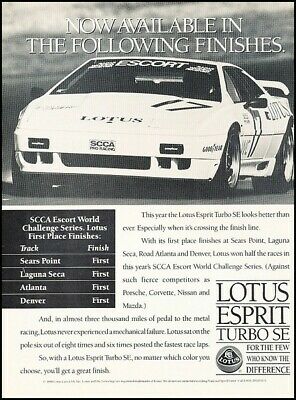
This was the inaugural year for SCCA’s World Challenge professional racing series for production based sports cars. It was thought that the Corvette would be unbeatable, as the Corvette Challenge series ended and numerous well-prepared Corvette teams moved over to World Challenge.
Type 105 race cars were entered as “Lotus Esprit Turbo”
This piqued Lotus’s interest and they pulled two Esprits off the assembly line and developed the Esprit into the Type 105 “X180R”, taking the internal Esprit model identifier X180 and appending “R” for racing.
Doc Bundy would take 2nd in the championship, after a crash in Dallas left him without the points to clinch the championship. Scott Lagasse taking 5th, the rest of the top nine drivers in the championship were all Corvette racers.
Lotus’s success prompted them to develop the twenty X180R cars with the bare minimum required to allow street registration, with their success highlighted by “World Challenge” decals on the front fenders.
At the end of the season, both X180R Type 105 race cars were sent back to Lotus Cars Ltd for upgrades to Type 106 (IMSA spec).
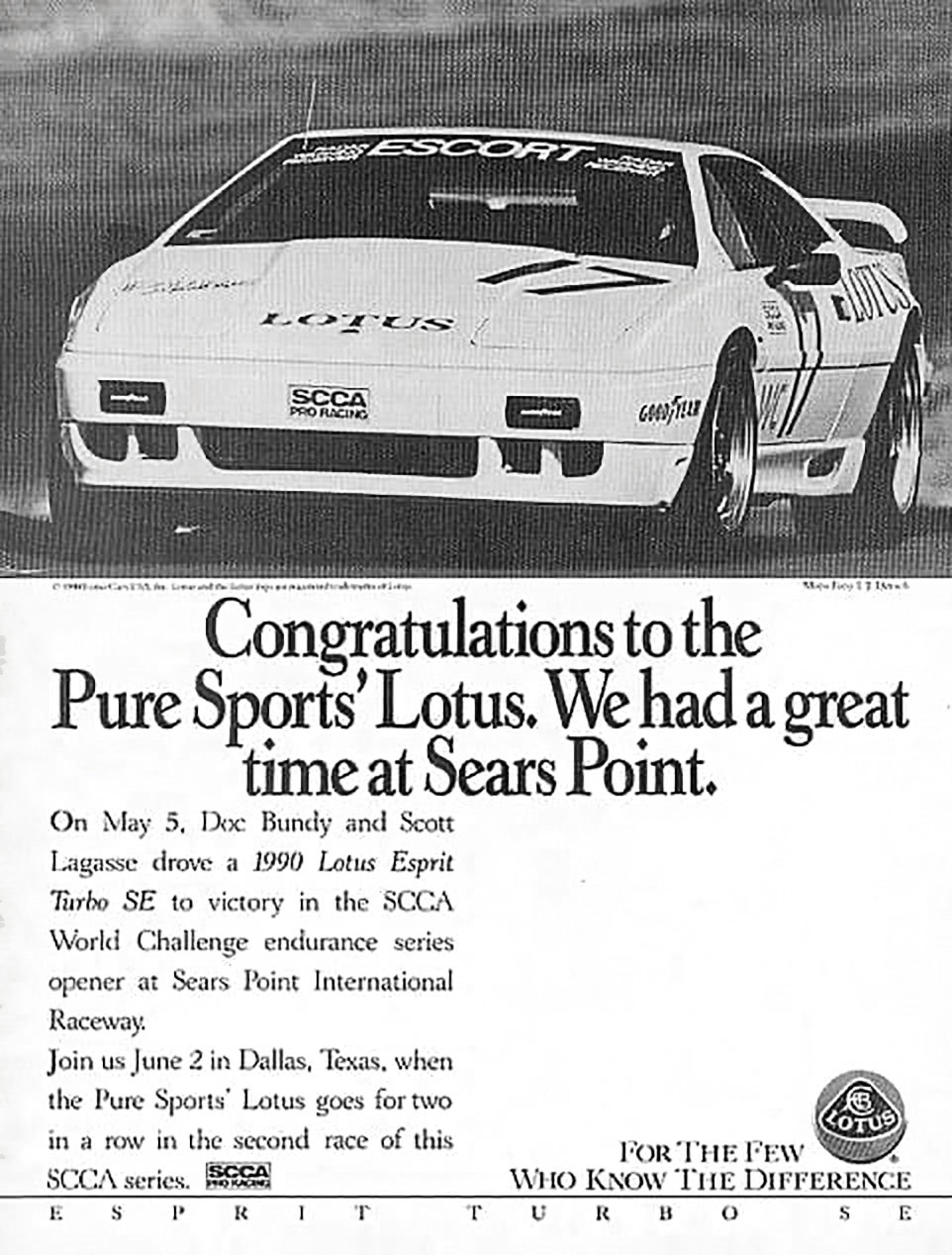
The First Race, by the Official Boxscore | SCCA Pro Racing’s final boxscore for Race 1 — Sears Point International Raceway, Sonoma, California, May 5, 1990 — fixes the debut in checkable numbers. The Pure Sports Lotus of Scott Lagasse and Doc Bundy started fifth and won, covering 92 laps of the 2.523-mile circuit for 232.116 miles in 3:00:22.50, an average of 77.211 mph, with a margin of victory of 7.761 seconds. Lou Gigliotti and Bobby Carradine’s Corvette led the opening six laps; the Lotus led from lap 7 to 49 and again from 53 to the finish. Lotus took the World Challenge manufacturers’ points for the round ahead of Chevrolet and Nissan.
The second round was the reverse of the first. At the Pontiac Grand Prix of Dallas in Addison on June 3 — a 45-minute race around a 1.57-mile circuit — Bundy qualified second at 70.212 mph but crashed out after ten laps; Lagasse retired with a mechanical failure after sixteen. It is the race that ultimately cost Bundy the championship. Both results are drawn from the official SCCA boxscores in the 1990 World Challenge archive.
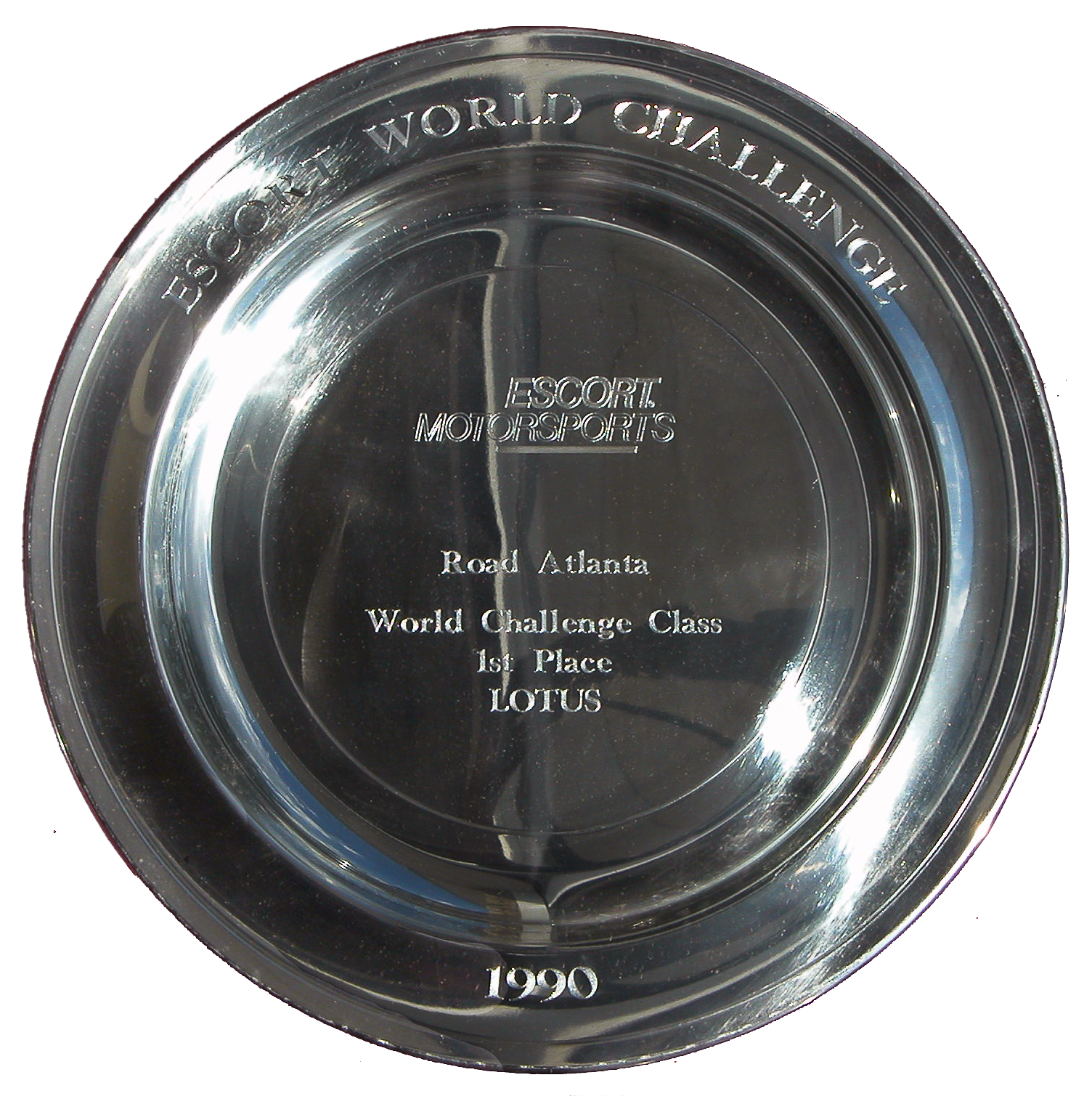
Laguna Seca, Des Moines, Road Atlanta, Mosport, Denver | The archive carries an official final boxscore for every round through Denver, and they fix the middle of the season in the same checkable numbers as the debut.
Fourteen Laps of Testing | What the boxscore cannot show is how little preparation stood behind that first win. Lotus Cars USA’s own press release, issued the following spring to announce the 1991 campaign, opens with a summary of the debut season and supplies the figure: “With only fourteen laps of testing before the season’s first race at Sears Point Raceway, a Lotus Esprit Turbo SE qualified fifth and went on to win, adding yet another notch in Lotus racing history.” The qualifying position corroborates the SCCA boxscore exactly. Fourteen laps of the 2.523-mile circuit is a shade over thirty-five miles — the entire development mileage the Type 105 had turned before it beat a grid of purpose-built Corvettes over three hours.
The same document records the Mosport enduro in terms the season summaries usually omit. John Miles, the former Team Lotus Formula One driver brought in as third driver, “returned to racing in 1990 with the 24-Hours of Mosport in a Lotus Esprit. The Lotus Team finished sixth after entering the first 24-Hour race since the last 24-Hour win for Lotus at Le Mans in 1964.” A sixth place overall, then — and, by the factory’s own reckoning, the marque’s first twenty-four-hour race in twenty-six years.
What the Racing Was For | Lotus Cars USA president Ronald Foster, quoted in the same release, stated the commercial logic of the whole exercise in a sentence — and it is the clearest surviving statement of why a company in Lotus’s financial position was spending money on a race team at all:
For years Lotus road cars have benefitted from on-track experience. We have already made changes to our production cars with the knowledge that we obtained from the 1990 racing season.
The release’s own tally of the 1990 record — “winning four races, six pole positions, three top ten finishes and three top five finishes” — does not match the researched season figures above, which record seven podiums rather than three top-five finishes. The discrepancy is the press release’s, not the archive’s: it is promotional copy written to a deadline, and its finishing categories overlap incoherently. The wins and the pole count, which are the checkable numbers, agree.
Source: Lotus Makes Successful Comeback — Racing in America, Lotus Cars USA, Inc., 1991. The release announces the 1991 season but opens with the definitive factory account of 1990.
| Pos | Driver | Team | Car | Points |
|---|---|---|---|---|
| 1 | R.K. Smith | Powell Motorsport | Corvette RG9 | 201.0 |
| 2 | Doc Bundy | Pure Sports | Lotus Esprit Turbo X180R | 183.0 |
| 5 | Scott Lagasse | Pure Sports | Lotus Esprit Turbo X180R | 168.0 |
| =39 | Rudy Thomann · David Murray · John Miles | Pure Sports (Mosport) | Lotus Esprit Turbo X180R | 19.0 |
Champion R.K. Smith finished 201.0 to Doc Bundy’s 183.0 — a margin of one race. Positions three, four, six, seven, eight and nine (Heinricy, Said, Pilgrim, Gigliotti, Poirier, Wallace) were all Corvette; Bundy and Lagasse were the only non-Corvette drivers in the top nine. Thomann, Murray and Miles scored their 19.0 as co-drivers of the No. 17 Lotus in the Mosport twenty-four-hour enduro.
| Pos | Car No. | Entrant | Car | Points |
|---|---|---|---|---|
| 1 | 98 | Mobil Oil | Corvette RG9 | 237.5 |
| 2 | 17 | Kenwood / Pure Sports | Lotus Esprit Turbo X180R | 222.0 |
| 3 | 4 | Bakeracing / Young Chevrolet | Corvette RG9 | 221.5 |
| 4 | 50 | Powell Motorsport | Corvette RG9 | 219.0 |
| 5 | 97 | Mobil Oil | Corvette RG9 | 198.5 |
| 6 | 5 | Valley Chevrolet | Corvette RG9 | 169.5 |
| 7 | 16 | Kenwood / Pure Sports | Lotus Esprit Turbo X180R | 164.0 |
The World Challenge scored points per car, not per team, so Pure Sports appears twice — and both of its Lotus Esprits finished in the top seven. The No. 17 car took second in the championship, 15.5 points behind the winning Mobil Oil Corvette. Verified against the season-ending team standings in the 1990 SCCA World Challenge archive, p. 44.
Alan Nobbs: Lotus powertrain engineer for racing team (hired from Corvette ZR-1 project)
John Miles: Lotus chassis development and third driver for 24 hour endurance race (former F1 driver for Lotus)
Colin Marriott: Lotus engineer on chassis, engine, etc
Richard Clarke: Lotus Cars USA field engineer (previously worked for Lotus Engineering in active F1 suspensions)
Rick Adley: Pure Sports team manager
Jim Bell: Pure Sports crew chief
Ron Foster: President of Lotus Cars USA
Winterbottom’s figures are reproduced verbatim in Origins and in the Winterbottom letter, and they are left exactly as he wrote them. The official SCCA timing-and-scoring boxscores in the 1990 World Challenge archive diverge on three points. Lap leadership: the lap-leader lines show no Lotus led a lap at Dallas (Hendricks 1–10, Emmick 11, Smith 12–33) or at Des Moines (Smith led all twenty-four), which caps the season at six races led rather than seven. Fastest laps: the archive names a Lotus fastest race lap at four rounds; Dallas’s belongs to Hendricks, Sears Point’s is printed unattributed, and Mosport’s as “Not Available.” Reliability: the Dallas boxscore classifies Lagasse’s car twenty-fifth, sixteen laps, status “Mech.” The 2,900-mile figure most plausibly describes the lead car’s running rather than both entries — Winterbottom does not say — and the letter remains the factory’s summary of its own season, not a scoring document. ↩︎
Doc Bundy 2nd, Scott Lagasse 5th (Drivers) · Lotus 2nd (Manufacturers)
The inaugural year of SCCA's World Challenge. Type 105 race cars were entered as "Lotus Esprit Turbo".