Sebring
Mar 18, 1994- P6Andy Pilgrim #14Grid 6th
Rising weight penalties bite — one win and seven podiums.
For 1994 IMSA added a further 100 lb, pushing the X180R’s minimum weight to 2,800 lb and leaving the aging chassis uncompetitive against newer machinery. Driven by Doc Bundy, Andy Pilgrim, Paul Newman, Bo Lemler, Scott Lagasse, and Peter Shea, the Esprits nonetheless reached the podium seven times across six of the eight Supercar rounds (75 percent), took one pole position, and scored a single win (12.5 percent) — Andy Pilgrim’s victory at Phoenix. Lotus finished third in the manufacturers’ championship, behind BMW and Nissan.
The rulebook, in its own words | IMSA published the number. Article 11.8.8 of the 1994 IMSA Code — the eligibility and tire-size list — sets the Lotus Esprit X180R’s minimum weight at 2,800 lb, against 3,200 lb for the Porsche 911 Turbo S2. The four-hundred-pound advantage the Esprit had been fighting on was still there on paper, and it was still not enough.
The same table records something easier to miss. Of the thirty-seven eligible models, only the two Lotus Esprits — the X180R and the road-going Esprit Turbo SE — were listed on sixteen-inch front wheels; every other make ran seventeens. And the X180R stood alone even among those two: it was the only car on the entire list with a staggered fitment, 225/50-16 at the front against 275/40-17 at the rear. The base Turbo SE never turned a wheel in Supercar, so on any actual grid the X180R ran its sixteen-inch front by itself. Three years after homologation, the rulebook was still writing the Esprit’s fitment around the car Lotus had actually built, rather than around the grid it was racing.
Every one of the 37 models eligible for the 1994 Bridgestone Supercar Championship, dropped onto the minimum weight the rulebook assigned it. The Esprit X180R sat 400 lb under the Porsche 911 Turbo S2 — and, with the base Esprit, was one of only 2 cars on the list mandated a sixteen-inch front wheel. Hover or focus any car for its mandated tires.
| Make | Min. weight | Front tire | Rear tire | Front |
|---|---|---|---|---|
| Mazda RX-7 (93–94) | 2,450 | 235/45-17 | 275/40-17 | 17″ |
| Lotus Esprit Turbo SE | 2,450 | 225/50-16 | 245/45-16 | 16″ |
| Ford Mustang SAAC MK II | 2,500 | 275/40-17 | 275/40-17 | 17″ |
| Porsche Carrera 2 | 2,500 | 235/45-17 | 275/40-17 | 17″ |
| Acura NSX | 2,550 | 235/45-17 | 275/40-17 | 17″ |
| Porsche 944 Turbo | 2,550 | 235/45-17 | 255/40-17 | 17″ |
| BMW M6 | 2,600 | 275/40-17 | 275/40-17 | 17″ |
| Porsche Carrera 4 | 2,600 | 235/45-17 | 275/40-17 | 17″ |
| BMW M5 | 2,700 | 275/40-17 | 315/35-17 | 17″ |
| Mercedes 300 CE | 2,700 | 275/40-17 | 275/40-17 | 17″ |
| Ferrari 348 | 2,750 | 235/45-17 | 255/40-17 | 17″ |
| Lotus Esprit X180R | 2,800 | 225/50-16 | 275/40-17 | 16″ |
| Corvette L-98 | 2,850 | 275/40-17 | 275/40-17 | 17″ |
| BMW 850i | 2,900 | 275/40-17 | 275/40-17 | 17″ |
| Pontiac Firebird Firehawk | 2,900 | 275/40-17 | 315/35-17 | 17″ |
| Pontiac Firebird Firehawk (93–94) | 2,900 | 275/40-17 | 315/35-17 | 17″ |
| Toyota Supra Turbo (93–94) | 2,900 | 275/40-17 | 315/35-17 | 17″ |
| Porsche 911 Turbo | 2,950 | 235/45-17 | 275/40-17 | 17″ |
| BMW 750iL | 3,000 | 275/40-17 | 275/40-17 | 17″ |
| Corvette LT1 | 3,000 | 275/40-17 | 315/35-17 | 17″ |
| Lexus SC 400 | 3,000 | 235/45-17 | 235/45-17 | 17″ |
| Nissan 300ZX-T Stillen | 3,000 | 275/40-17 | 315/35-17 | 17″ |
| Porsche 928 GT | 3,000 | 275/40-17 | 315/35-17 | 17″ |
| Porsche 928 S4 | 3,000 | 275/40-17 | 315/35-17 | 17″ |
| Callaway Corvette CL-1 | 3,100 | 275/40-17 | 315/35-17 | 17″ |
| Dodge Stealth | 3,100 | 255/40-17 | 255/40-17 | 17″ |
| Ferrari Testarossa | 3,100 | 275/40-17 | 275/40-17 | 17″ |
| Mercedes 300 SL | 3,100 | 275/40-17 | 275/40-17 | 17″ |
| Corvette ZR-1 | 3,200 | 275/40-17 | 315/35-17 | 17″ |
| Callaway Corvette CR-1 | 3,200 | 275/40-17 | 315/35-17 | 17″ |
| Jaguar XJ-S | 3,200 | 275/40-17 | 275/40-17 | 17″ |
| Mercedes 500 SL | 3,200 | 275/40-17 | 275/40-17 | 17″ |
| Porsche 911 Turbo (93–94) | 3,200 | 235/45-17 | 275/40-17 | 17″ |
| Porsche 911 Turbo S2 (1992) | 3,200 | 235/45-17 | 275/40-17 | 17″ |
| Dodge Viper | 3,250 | 275/40-17 | 335/35-17 | 17″ |
| Callaway Corvette | 3,300 | 275/40-17 | 315/35-17 | 17″ |
| Mercedes 500 E | 3,300 | 275/40-17 | 275/40-17 | 17″ |
The weight and the front rim diameter of every car were read directly from the page; the two Lotus Esprits are the only entries on a sixteen-inch front, and the X180R is the only car of any make on a staggered sixteen-front / seventeen-rear fitment. The base Esprit Turbo SE shared the front wheel but was never campaigned, so on any Supercar grid the X180R ran it alone. A few rear-tire aspect ratios came through a garbled OCR of the typed sheet and are set to the one standard designation they can represent; where a model lists a single size it applied front and rear.
Source 1994 IMSA Code, Article 11.8.8 — Eligibility and Tire Size List, p. 71.
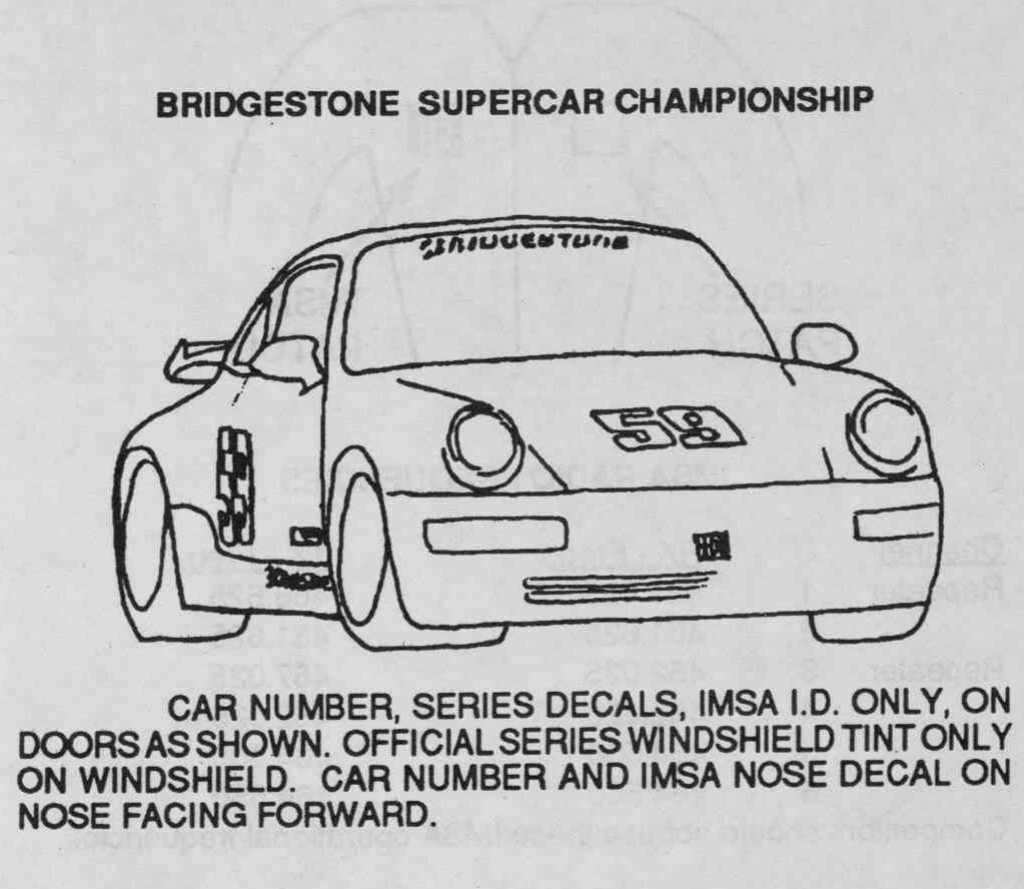
The rulebook’s idea of a Supercar | Article 13 of the Code sets out the car-identification diagrams: exactly where a competitor may place the car number, the series decals and the IMSA identification, and nowhere else. “Car number, series decals, IMSA I.D. only, on doors as shown. Official series windshield tint only on windshield.”
The drawing IMSA chose to illustrate the Bridgestone Supercar Championship is a Porsche 911. It wears No. 58 — the number of the Brumos car that appears on Porsche’s own championship poster. The sanctioning body’s picture of what a Supercar is, printed in the rulebook the Lotus team raced under, is a drawing of the car that beat them. No Esprit appears anywhere in the book’s diagrams.
How the ballast was actually applied | The rulebook also describes the mechanism the season is usually told through. Article 11.8.4 gives IMSA the power to “determine and publish an official minimum weight for each eligible make and model,” to be taken without driver or fuel aboard; ballast, where required, “must be bolted or welded to the chassis”; and adjustments are made “in a maximum of 50 lb increments.” The weight was not a penalty invented race by race. It was a published figure, adjusted in fifty-pound steps, and the Esprit’s had climbed by 225 lb in three seasons.
Lotus 3rd (Manufacturers, behind BMW and Nissan)
Doc Bundy ran only 2 of the 9 races for IMSA Exxon Supreme Championship for GTU; ending 26th in the Driver's Championship (out of 48 drivers).