The Lotus Esprit X180R was built to satisfy a rule, and so was its rival. When IMSA opened the Bridgestone Potenza Supercar Championship for 1991, the sanctioning body’s twenty-car homologation clause bound every manufacturer equally: Lotus answered it with twenty stripped, caged Esprits, and Porsche answered it with twenty road-legal 911 Turbos it labelled the Turbo S2. This page is the dossier on the Stuttgart car — its numbers, the import scheme that got it into the country, its two championships, and the one thing about it that the record still cannot agree on. The rivalry as a story is told from the Lotus side of the paddock in The Rival: Porsche 964 Turbo S2; the seasons the two cars contested are in the racing record; the definitive Porsche-side history belongs to Christoph Maeder’s chapter in the forthcoming book.
Power and weight are each marque’s own published figures for the homologation car, and the pounds-per-horsepower line is simple arithmetic on them — not an independent measurement. Both figures are contested: Porsche’s 322 bhp is widely held to be conservative (see below), and the X180R’s race weight varied race to race under IMSA’s success-ballast rules. Read the ratio as what the two companies claimed, not as what the cars did.
The rival, as delivered
Dossier — Porsche 911 (964) Turbo S2, USA
- Model year
- 1992
- Cars built
- 20Delivery split disputed — see below.
- Engine
- Type M30/69 — 3.3-liter turbocharged flat-six, air-cooled
- Induction
- ANDIAL power kit: uprated K27 turbocharger, larger intercooler
- Heads & cams
- Ported-and-polished cylinder heads, revised camshafts
- Power, advertised
- 322 bhp @ 5,750 rpm
- Power, estimated
- 380–400 bhpInformed estimate, not a factory figure.
- Torque
- 332 lb-ft (450 Nm) @ 4,500 rpm
- Weight
- 2,822 lb (1,280 kg)
- Drivetrain
- Rear engine, rear-wheel drive, 5-speed manual
- “S2” power-kit option
- $10,065 on the Monroney sticker
- Delivered price
- $119,005 before further options
- Finisher & importer
- ANDIAL, California, for Porsche Motorsports North America
- Interior
- Fully trimmed — no factory roll cage, no racing harness, no stripped cabin
Figures as the ANDIAL-finished cars reached their US dealers. Where the record is contested, the uncertainty is carried in the table rather than resolved out of it. Sources: The Drive’s history of the model, Stuttcars, and dealer catalog listings.
Why exactly twenty
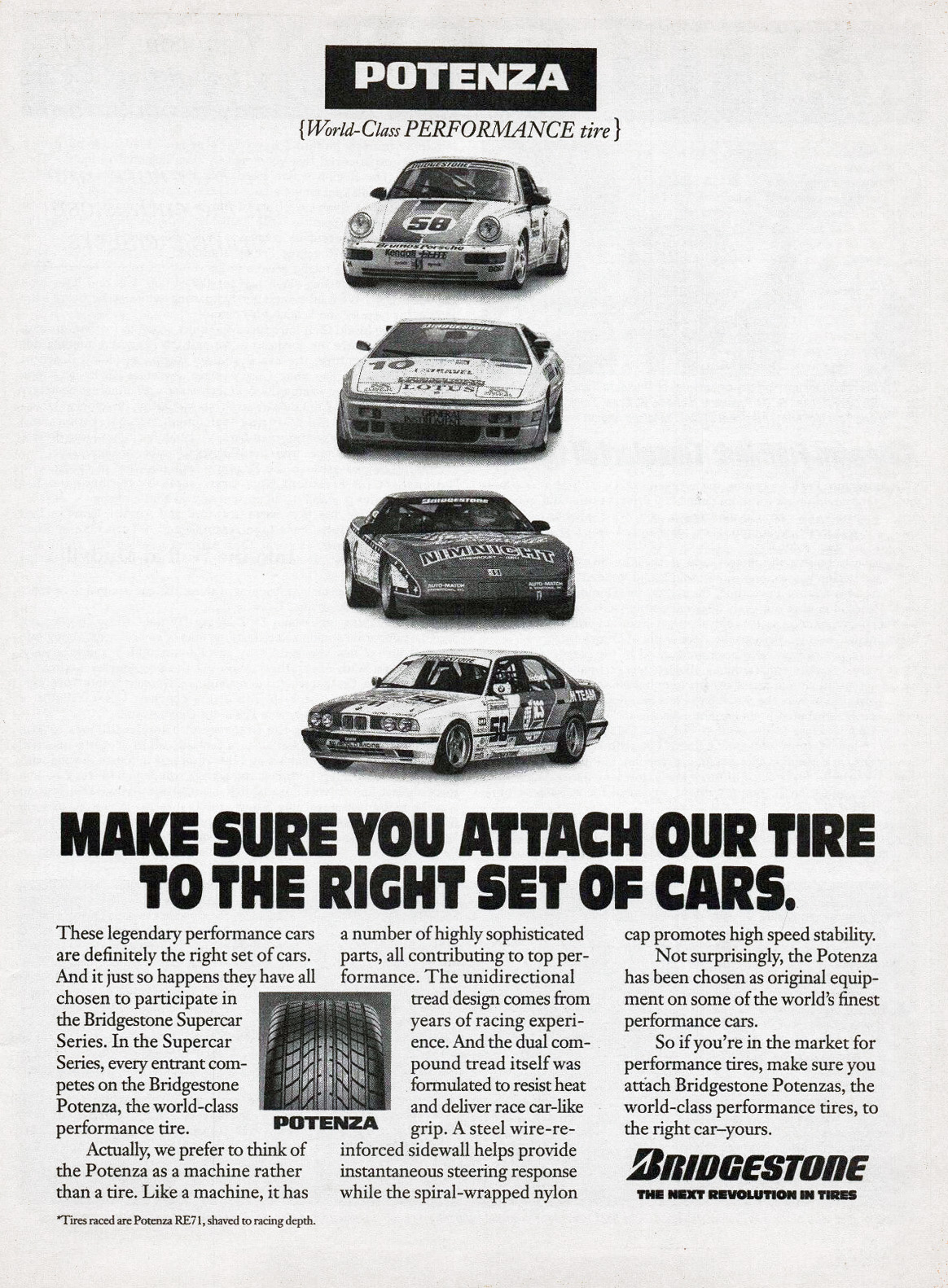
The same clause that forced Lotus’s hand | IMSA’s Supercar rules demanded that a manufacturer build at least 200 nearly identical road cars for the US market, plus a run of at least twenty that shared “most of the primary components of the race car,” all sold road-legal in North America. Twenty was therefore not a marketing number but the exact floor the rulebook set — the identical figure that produced twenty X180Rs on the Lotus side. Porsche had 200-plus 964 Turbos in its US catalog already; what it lacked was the twenty near-race-specification cars, and the Turbo S2 was built to be precisely that count and no more.
Why the Turbo, not a lighter Porsche | Porsche owned more obviously competitive homologation bases — the 964 Carrera RS and its N-GT variants — but those had been developed past anything the company was prepared to federalize and sell for street use in the United States. The homologation clause’s insistence on road-legal, US-market cars ruled them out. The 964 Turbo, already a production model Porsche sold worldwide, was the safer starting point for a car that had to survive both a customer’s driveway and IMSA’s technical inspection.
The count that will not settle
Twenty is the number this rivalry turns on, and it is the one number about the Porsche that the record cannot agree on. The source material assembled for this project says Porsche built “exactly 20” Turbo S2s, and that the cars reached customers through eighteen US dealers and two in Canada. Those two statements can be read two ways, and the readings do not produce the same car count.
Twenty cars for the United States, plus two more delivered in Canada.
Porsche cleared the twenty-car floor in the US market alone and the Canadian pair were additional — a comfortable margin over the rule, and not a mirror of Lotus's twenty at all.
Twenty cars in total, comprising eighteen through US dealers and two in Canada.
Porsche built the bare minimum the rulebook allowed — twenty road-legal cars landed in North America, exactly as Lotus did. The rule said twenty; Stuttgart built twenty.
Several published histories describe the second reading — eighteen US cars and two Canadian, twenty in all. The distinction is not pedantry. Under reading two the two homologation specials are precise mirrors of one another, each manufacturer building the literal minimum a rulebook demanded and not one car more, which is the whole shape of this rivalry. Under reading one the symmetry is a coincidence of rounding.
What would settle it | Each Turbo S2 carries the “S2” power-kit option on its Porsche Certificate of Authenticity, and the cars passed through ANDIAL before distribution. A chassis-by-chassis list drawn from those certificates and from Porsche Motorsports North America’s delivery records would close the question in an afternoon. Until someone assembles it, this site records the count as twenty and the delivery split as unresolved. Corrections from owners and from the Porsche archive are welcome.
The ANDIAL import gambit
A scheme born of the 959 | Porsche approached the US regulators warily, and with reason. The company had never succeeded in federalizing the 959 for road sale in America — the DOT and EPA would not admit the car under the normal route, and it reached US owners only years later through “Show or Display” and private compliance work. Unwilling to again present federal inspectors with a modified, race-tuned road car, Porsche’s American motorsport arm engineered a way around the problem. Published accounts credit driver Hans Stuck and Alwin Springer — head of Porsche Motorsports North America and principal of the California tuning house ANDIAL — with lobbying the factory to get creative.
Two cars, both legal | The solution split the car in two. Porsche exported the twenty examples to ANDIAL as fully-optioned, stock-specification USA 964 Turbos, so that what crossed the border and cleared EPA and DOT inspection was an already-certified production model with no drastic modifications. Only once the cars reached ANDIAL in California did the tuner fit the homologated power kit that turned a Turbo into a Turbo S2, before the finished cars went to dealers. In effect the car that passed federal import inspection and the car that reached the customer were not quite the same specification — and both were legal.
The number that mattered was not the horsepower | The advertised result of the power kit was 322 bhp, a figure widely regarded as conservative; informed estimates put the true output nearer 380–400 bhp. But the number IMSA cared about was not on the dynamometer. The kit had to be a homologated, cataloged Porsche option, and it was: it appears on the Monroney window sticker as the “911 Turbo S2,” priced at $10,065, and on each car’s Porsche Certificate of Authenticity. Technically legal under IMSA’s own rulebook, the “S2” designation nonetheless existed in no small part to make the ANDIAL-tuned specification the production car of record — the same maneuver, in spirit, that Lotus performed by registering a caged racer as a road car.
Two titles to one
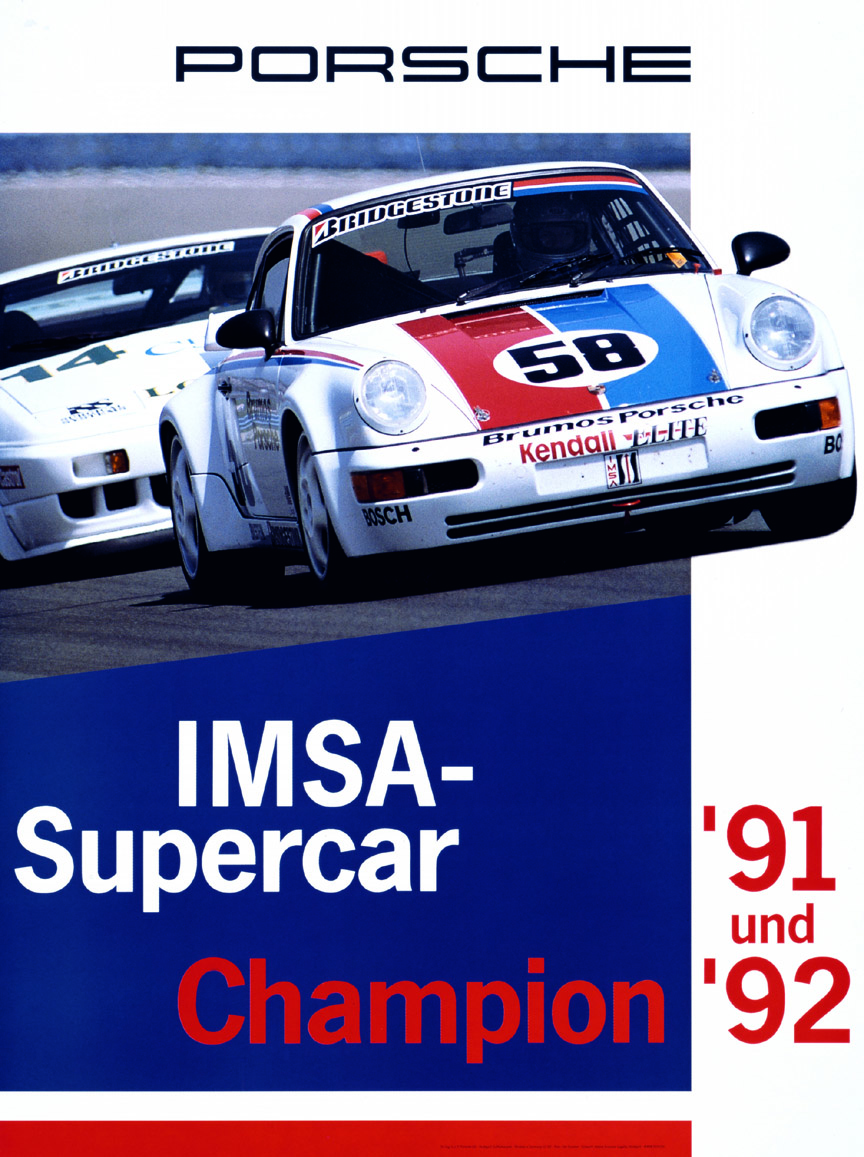
A poster, and what it does not say | Porsche marked the campaign with the poster reproduced here: the No. 58 Brumos car at speed, and across the foot of it, “IMSA-Supercar Champion ‘91 und ‘92.” It is worth reading closely, because it is a factory promotional document and those have a habit of being precise in a way that is easy to misread.
In 1991 Porsche won the Drivers’ Championship, with Hurley Haywood. In 1992 it did not. The 1992 drivers’ title went to Doc Bundy, in the Lotus — and Porsche’s championship that year was the Manufacturers’ title, which it took from Lotus by three points, 149 to 146. Both of Porsche’s claims are true. Neither is the same championship, and the poster names neither. A reader who did not already know the record would take it for two drivers’ titles in a row.
Across the three seasons in which the two cars met, the championship went to Stuttgart twice and to Hethel once. The middle year is the one Lotus keeps.
The race-by-race results published on this site are transcribed from LotuSport’s own records, which list the Lotus entries only. A round-by-round head-to-head against the Porsche cars is therefore not something this site can honestly print — it would mean inventing finishing positions for cars whose results we have not sourced. The championship outcomes above are what the record supports, and no more.
The men on the other side
Led the Porsche effort in the series' first season and took the inaugural 1991 Bridgestone Supercar Drivers' Championship with 124 points.
1993 Drivers' champion with 212 points. In October 1991 qualifying at Del Mar he set a series course record of 72.972 mph, knocking Lotus's Bobby Carradine off provisional pole in the final minute.
President of Porsche Motorsports North America and principal of ANDIAL, the California tuning house that received the twenty cars and fitted the power kit that made them Turbo S2s.
Where to read further
The rivalry as it looked from inside the Lotus garage — the protests, Stuck’s Del Mar pole, the Lime Rock disqualification of David Murry’s winning X180R over a turbocharger that was, by Lotus’s own records, the correct part — is told in The Rival: Porsche 964 Turbo S2. The seasons in which the two cars met are set out year by year in the racing record. The definitive Porsche-side history of the Turbo S2 and its Supercar campaign is a dedicated chapter by Christoph Maeder in the forthcoming book. For the era’s other comparable homologation specials — the 964 Carrera Cup, the Japan-market 964 RS N-GT Clubsport, the Ferrari 348 GT Competizione and 355 Challenge among them — see “Similar Contemporary Cars” on the References page.