Part Three Legacy
By the middle of 1995 the Esprit X180R had raced its last professional season, undone not by a faster rival but by the very success that had loaded its chassis with penalty weight year after year. What followed was a quiet decade of dispersal — two cars to a sponsor, one to Pennsylvania, two to Arizona, and a brief, underfunded Speedvision revival crewed alongside a UFO-religion founder — before a two-man team resurrected the LotuSport name, restored three of the survivors, and returned the championship car to the hill at Goodwood. This chapter follows the five factory race cars out of competition and into their afterlife.
The End of the Factory Program
The X180R did not lose its edge so much as have it legislated away. To keep the fast-improving Lotus in check, IMSA raised the car’s minimum weight almost every season — from the 2,575 lb (1,168 kg) floor of the 1992 title year to 2,700 lb (1,225 kg) in 1993 and 2,800 lb (1,270 kg) in 1994, each figure before the additional penalty weight added to an individual chassis after a win. (The full progression, with tire sizes by year, is tabulated on the racing overview.) By 1995 the accumulated ballast on a four-season-old design, combined with the loss of Lotus factory support, left the car no longer competitive.
A season cut shortLotuSport ran only the opening rounds of 1995 before shutting the program down. The record was thin but not without honor: across Sebring, Long Beach and Lime Rock the team took one pole — Bo Lemler starting first at the March 18 Sebring opener — and one podium, Andy Pilgrim’s third place at Lime Rock on May 27. The full results are preserved on the 1995 season page.
The drivers moved onThe end of the factory effort scattered the driver roster to other machinery mid-season. Andy Pilgrim ran a 350 hp Pontiac Firebird Firehawk after the first three Supercar races in an X180R, and Doc Bundy — the man who had pitched Lotus on the series in the first place and won it the 1992 Drivers’ title — contested one final Supercar race in a Nissan 300ZX Turbo. The cars they left behind sat, as the racing overview puts it, “until being sold off.”
Dispersal: Where the Five Cars Went
Five factory race cars — three Type 106s built new for 1991 plus the two 1990 Type 105s later upgraded to Type 106 specification — came out of the LotuSport shop and, over the following years, out of Lotus Cars USA’s hands. Where each of them went can be reconstructed in outline but not by chassis: the accounts name owners and count cars, and almost never give a VIN.
The sponsor’s carsCar #12 went to Steve Hansen, described in the site’s own racing pages as a LotuSport sponsor and driver. The later Vintage Race Car Sales listing tells a fuller version, recording that “two of the cars remained in the Atlanta area, including the car that Doc Bundy heavily damaged in a race crash at Sebring in 1993,” and that “these two cars were purchased by Steve Hanson, one of the team’s drivers and sponsors.” Whether “Steve Hansen” (the LotuSport sponsor named in the race records) and “Steve Hanson” (as spelled in the dealer listing, and in the registry as a first owner) are the same man is not established here. The same source names a further car sold to Kyle Kaulback in Pennsylvania.
Two to Arizona, and one on loanHow many cars reached Bruce Morton’s Move-It Motorsports operation in Arizona for the 2000 Speedvision revival is the figure this history has most often got wrong. Move-It entered three X180Rs at the season opener at Charlotte on March 31, 2000 — Elliott Forbes-Robinson (No. 55), Butch Leitzinger (No. 95) and “Raël” (No. 65), the last of them under a Move-It Motorsports / UFOland banner — and it is tempting to read three cars on the grid as three cars sold. An entry list records who entered a car. It does not record who owned it.
The number is two, and it is settled by the man who later bought the cars from him. Writing in Lotus ReMarque, the official publication of Lotus, Ltd., in August 2005, Kevin McGovern of Yesteryear Motorsports set down his own purchases in plain sequence. Late in 2002, he records, “several of the cars came up for sale. I decided to buy one and purchased car #12 from Steve Hansen, one of the team sponsors and occasional driver.” Then, over the winter of 2004–05, “we also ended up buying two more of the race cars. These two cars had been sold by Lotus to Bruce Morton who entered them in the Speedvision Series with Elliot Forbes Robinson and Butch Leitzinger driving. The season ended early when expected sponsorship failed to arrive and the cars had been sitting since then.”
Two cars, then, went to Arizona, bought from Lotus — not, as this site long had it, from LotuSport. The third car at Charlotte was Hansen’s No. 12, lent rather than sold. A 2012 British Racing Group advertisement for that car, “Eleanor,” supplies the mechanism in as many words: after LotuSport shut down, “Eleanor was sold to Steve Hansen who in turn leased her out to the Move-It Motorsports team,” and “Move-It raced Eleanor in the inaugural Speedvision GT series race at Charlotte Motor Speedway as part of a 3 Esprit team.” Two bought and one leased, and the dispersal of the five closes without remainder: two to Hansen, one to Kyle Kaulback in Pennsylvania, two to Morton.
It is worth being exact about how this site got it wrong, because the error was one of method. The Vintage Race Car Sales listing reproduced on the chassis 52591001 page says “the two remaining cars eventually were purchased by Bruce Morton in Arizona,” and elsewhere that Yesteryear Motorsports “acquired three of the cars” in 2002. This site read those two figures as a contradiction and resolved it by inferring three sales from the three-car entry list. They were never a contradiction: they describe different transactions, and McGovern’s account shows the three Yesteryear cars were not even bought at one time or from one seller — No. 12 from Hansen late in 2002, the two ex-Morton cars more than two years later. The inference was wrong, and so was the count it produced. Both have been corrected throughout.
What is still not knownWhich two chassis Morton bought is not established: no source names the Arizona cars by VIN, and the period results log a car number, never a chassis. Nor is it established which of the three numbers at Charlotte — 55, 95 or 65 — was carried by the leased No. 12. There is, however, a document that would settle it. McGovern records that when Yesteryear bought out Jack Ansley’s remaining LotuSport effects, the haul included “original bills of sale for the five cars from Lotus UK.” Those five bills of sale, if they survive, are the factory build-and-sale record this registry has never had.
Reasoned, not sourced
Move-It Motorsports and the 2000 Speedvision World Challenge GT
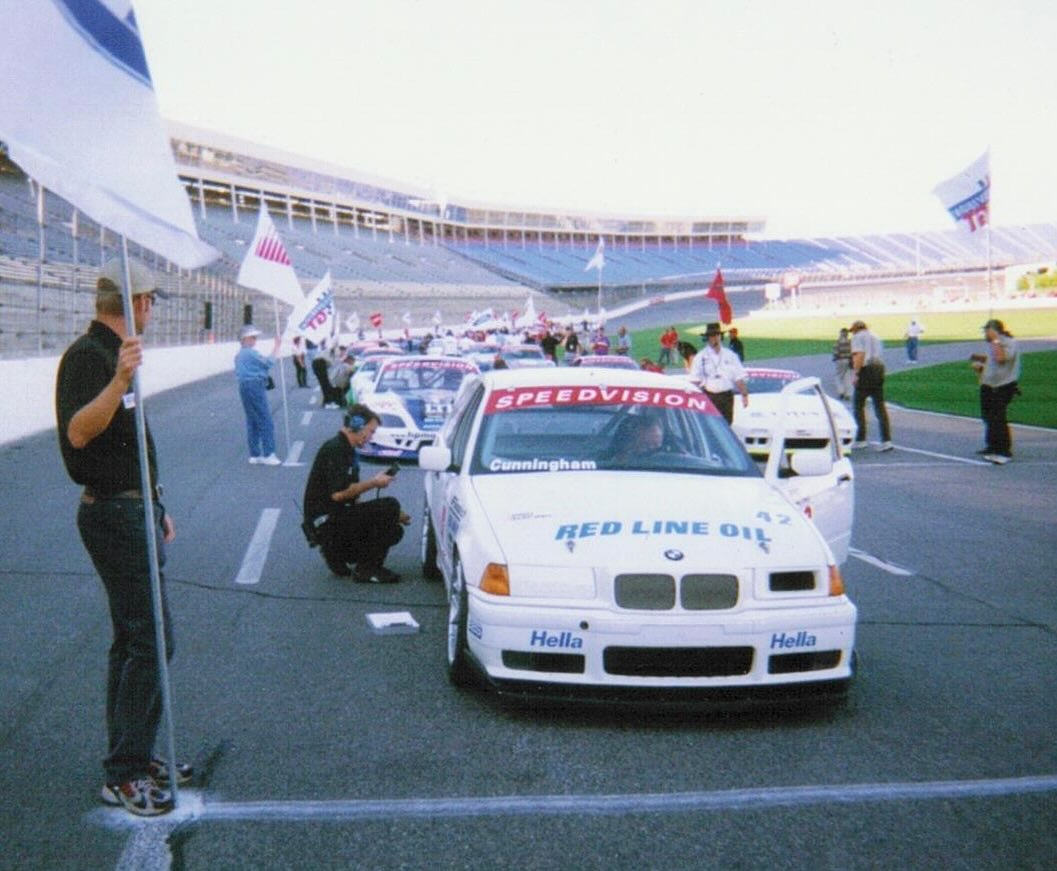
Five years after the factory program closed, the X180R made one last professional appearance. Bruce Morton’s Move-It Motorsports team bought two of the IMSA cars, leased a third — car No. 12 — from Steve Hansen, and modified them to run in the 2000 Speedvision World Challenge GT series, with Elliott Forbes-Robinson and Butch Leitzinger, both accomplished sports-car professionals, signed to drive. Hopes ran ahead of the budget.
The Charlotte openerThe team fielded all three cars at Charlotte on March 31, 2000, at what was the first-ever standing start for the World Challenge GT Championship. Forbes-Robinson qualified the #55 at 1:22.020 (98.756 mph / 158.933 km/h) and brought it home ninth, the team’s best result of the year. Leitzinger’s #95 retired after 17 laps and the #65 after 15. It would prove to be the only round the team fully contested.
Underfunded and outFor want of funding, Move-It Motorsports could not sustain the three-car effort. The #65 ran two further rounds and Forbes-Robinson returned once more in the #55 at Texas Motor Speedway on September 3, closing the season with 26 points and 31st place overall — a quiet end to the Lotus X180R’s professional racing history. Full results are on the 2000 season page.
Raël and UFOlandThe most unusual footnote of the 2000 season belongs to the #65 car, entered under the “Move-It Motorsports / UFOland” banner and driven by “Raël” — the pseudonym of Claude Vorilhon, founder of the Raëlian movement. Vorilhon contested Charlotte, Mosport (May 21) and Lime Rock (May 27), his best finish an 18th at Mosport. The car’s livery evolved mid-season, gaining a green front-splitter decal and a “Rael” decal on the hood while the mirror remained red.
Dormancy and the Yesteryear Motorsports Revival
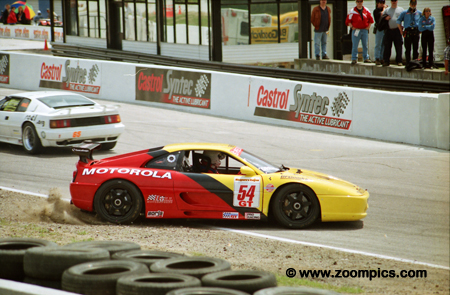
After the 2000 season the cars went dormant again. Their revival came from Yesteryear Motorsports Racing owners Kevin McGovern and Jaime Goffaux, who gathered three of the surviving chassis — one of the 1990 cars and two of the 1991 cars — and set about resurrecting the team, going so far as to acquire the LotuSport name itself, and Jack Ansley’s remaining team effects with it, from the original team owner.
The three were not bought at once, and the dealer listing that says they were is wrong on the point. McGovern’s own account has him buying car No. 12 from Steve Hansen late in 2002, racing it at Virginia International Raceway in October 2004, and only over the following winter — after the car broke a transmission at VIR — “buying two more of the race cars,” the pair that had gone from Lotus to Bruce Morton and had sat since the Speedvision season collapsed. The restored cars were returned to 1991/1994 Supercar specification and campaigned in vintage racing.
The clearest single account of the resurrection comes from the Vintage Race Car Sales listing for the first Type 106, offered in October 2020 and reproduced verbatim as a period document:
In 2002, Yesteryear Motorsports Racing owners Kevin McGovern and Jaime Goffaux acquired three of the cars including one of the 1990 cars and two of the 1991 cars and began the resurrection of the LotuSport team acquiring the name from Jack Ansley. These cars have been race restored to the 1991/1994 Supercar series specifications, sorted, and competitively run in Vintage Racing events ever since — including invitation and attendance to the Goodwood Festival of Speed for the championship car in the summer of 2012. A standing invitation for return remains to present day.
— Vintage Race Car Sales listing for VIN SCC 52591001, October 2020
Goodwood, 2012
The high point of the vintage era belongs to the first Type 106 — VIN SCC 52591001, the 1992 IMSA championship car and, per the dealer listing, “the first X180R Type 106 constructed by Lotus Cars” and “overall winner of over 10 Professional IMSA and SCCA World Challenge races.” In the summer of 2012 that car was invited to and attended the Goodwood Festival of Speed, running the hill at the world’s foremost celebration of competition machinery, with a standing invitation to return. Its full provenance and preparation record — chassis strengthening by GMT Racing, an original documented 1993-season Lotus engine, Moton dampers, AP Racing brakes and the rest — is preserved on the chassis 52591001 page.
The Cars Today
Of the five factory X180Rs, the vintage-restored survivors continue to appear at historic events, and several road-going homologation cars have surfaced at auction and in private collections in the decades since. For the current whereabouts, ownership chains and condition of the individual chassis — road and race alike — see the X180R Registry.
The cars, in the end, outlived the rules that retired them. But the X180R was never only its aluminum and fiberglass; it was Doc Bundy’s pitch, Jack Ansley’s team, Oliver Winterbottom’s late-October homologation scramble and a garage full of drivers who made a 30-minute sprint the best racing many of them had ever seen. The next chapter turns to the people who built, drove and remembered it.