Part Three Legacy
The X180R was conceived for one market and one purpose: to homologate a race car for the United States. Yet twice Lotus looked at the finished product and wondered whether the idea could travel further — first by offering the race-replica itself to its European importers, and later, more successfully, by softening it into a road car that could be sold across Europe and then taken racing at Le Mans. Neither path led where Hethel hoped. The European X180R was never built for sale, and the Esprit Sport 300 that followed found the podium at neither of its two visits to the Circuit de la Sarthe. Both stories, however, are essential to understanding what the X180R was — and what it was not.
The European Pitch
“Just Look at That Margin”In late 1990, Lotus Sales Director Mike Bishop gathered the company’s European importers for a meeting to discuss new models, and set the first item on the agenda to a proposal for an “ultra high performance Esprit.” Bishop was canvassing his dealers for feedback — gauging whether any of them would be willing to offer the X180R “Race Replica” within their own markets. To make the case, Lotus prepared a coil-bound binder resembling the X180R Owner’s Manual Supplement, filled with internal discussion points for the importers. The presentation folded in the whole existing dossier on the car: Oliver Winterbottom’s letter on the X180R (reproduced on this site as the Winterbottom foreword) and the full set of X180R technical specification sheets. The pitch noted that twenty had already been commissioned and “sold” by Lotus Cars USA, and put the opportunity plainly — that “the opportunity now exists to build some for other markets if there is a demand.”
The European car was to be all but identical to the North American version. The binder specified only the changes demanded by local regulation: “a European non airbag steering wheel is fitted, the vehicle is fitted with knee restraint and the airbag sensor system.” As in the United States, the purchase was to be an experience as much as a transaction — each buyer would receive “customer tuition on the track” and a seat “fitting” at the Lotus factory in Hethel.

The Margin, and the SilenceThe commercial terms were where the pitch turned emphatic. The importer’s purchase price from the factory was to be £55,000 (approximately $78,500 USD at the time), with each importer free to set an adjusted final price — with an appropriate markup — in the currency of its own market. The notes closed with an appeal to the dealers’ arithmetic rather than their enthusiasm: “JUST LOOK AT THAT MARGIN & LOOK AT THE CAR…”
JUST LOOK AT THAT MARGIN & LOOK AT THE CAR…
For all the confidence of that flourish, the response was silence. None of the European Lotus importers or dealers chose to offer the race-focused X180R. Lotus left no record of their reasoning, and the honest position is that the reasons are unknown. It is not hard to guess at them — the importers may well have caught wind of Lotus Cars USA’s own difficulty in moving so expensive and so specialized a machine, a struggle documented in the homologation chapter and visible in the 1992 advertisements Lotus ran to shift the last unsold cars. But that is inference, not evidence.
The Extra Car at HethelOne detail in the binder has outlived the pitch itself. In making its case, the presentation mentioned that Lotus had built an additional X180R race replica, kept at the Hethel test track for customer demonstrations. This is a car outside the canonical count of twenty road cars and five factory racers — a twenty-first X180R, built to be driven by prospective European buyers who never materialized. Whether this additional X180R still exists is unknown. No chassis number for it survives in the registry, and the registry records the same open question. (The registry dates the importer pitch to late 1991 rather than late 1990; the discrepancy of a year is unresolved, and turns on which internal document a reader trusts.) It is entirely possible the demonstration car was one of the known chassis pressed into show duty and later renumbered, or a genuinely separate build long since dispersed. The record does not say, and the gap is not closed here by invention.
Sport 300 — The X180R’s Successor
Where the European X180R was the race car offered as a road car and refused, the Esprit Sport 300 was the reverse: a road car built to go racing, and this time the European market took it. While Lotus’s importers declined the hard-edged X180R, the more comfort-oriented Sport 300 reached them in 1993.
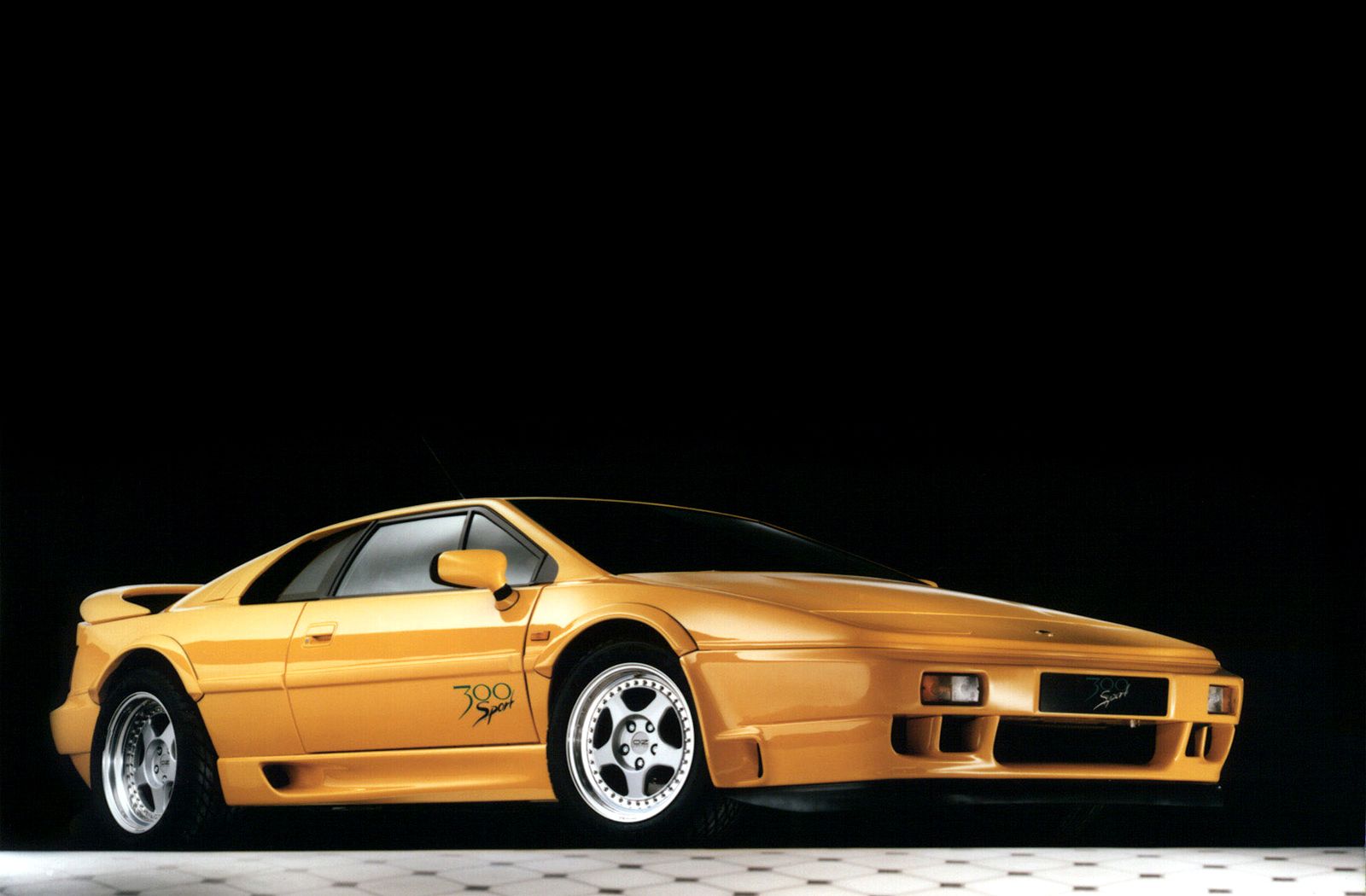
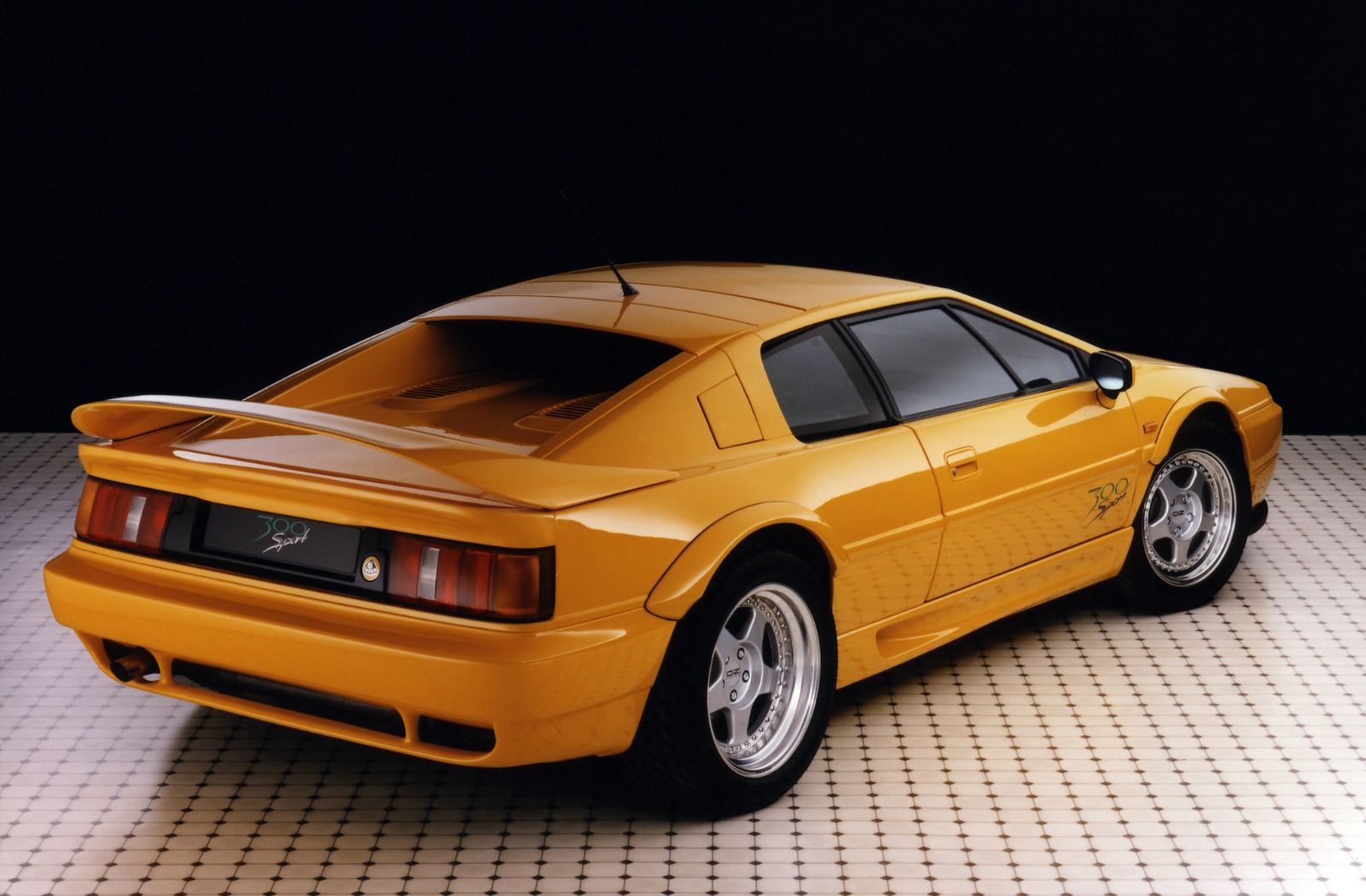
A Track Car, Not a Race CarThe distinction matters, and Lotus drew it deliberately. Similar to the X180R in silhouette and in the engine under its deck, the Sport 300 was positioned by its base specification as a high-performance track car rather than an out-and-out racer. The central difference was structural. The Sport 300 lacked the full roll cage mated directly to the chassis that gave the X180R its exceptional stiffness — the defining feature detailed in Building the Car at Hethel. In its place, the Sport 300 used a four-point braced frame. The result was a body far more rigid than a standard Esprit’s, but not the near-competition tub of the X180R. For customers who wanted to close that gap, Lotus offered the optional LotusSport competition package, which took the car back toward its X180R roots with a full bolt-in roll cage, racing seat belts, and a fire extinguisher.
The Name and the NumbersThe Sport 300 took its name from the output of its engine: the same 2,174 cc four-cylinder Type 910S that powered the X180R produced more than 300 horsepower on full boost from its Garrett turbocharger. Independent specification records put the figure at roughly 302 bhp (306 PS / 225 kW) — comfortably clearing the 300 mark the badge promised.
The factory quoted 0–60 mph in 4.7 seconds and 0–100 mph in 11.7 seconds, with a top speed near 168 mph (270 km/h) on a kerb weight of about 2,880 lb (1,306 kg). Quick, then, but by design a step behind the homologation X180R’s ~286 hp car with its sub-4.6-second 0–60 and ~170 mph reach — the price of trading the welded-in cage for a more livable road car. Lotus ultimately produced 64 Sport 300s across the 1993–1994 production run.
The Factory’s Own SheetLotus Cars Limited issued a two-page leaflet for the car, and it is the most direct statement of the Sport 300’s parentage that survives. The factory does not present the Sport 300 as an Esprit with options. It presents it as the X180R’s inheritance, in as many words: the car is “a lightweight ultra-high-performance road-going derivative of the Lotus Esprit X180R racer,” and — the sentence that matters most — “Not only is the Sport 300 derived from three years’ experience with the X180R racer — it is suitable for track use itself with the addition of a LotusSport competition pack comprising rollcage, full harness, and fire extinguisher, for which mountings have been provided.” The mountings, in other words, were already in the car. The cage was the only thing missing, and the factory had drilled the holes for it.
The leaflet’s technical specification is the factory’s, and it should be read as such. It quotes 300 bhp at 6,500 rpm from the chargecooled 2.2-litre four — a reworked and ported cylinder head, a hybrid Garrett turbocharger, additional chargecooler capacity, a recalibrated engine-management system — and a body “weighing about 250lbs less than the Esprit SE.” Its brakes are given as increased-diameter discs with AP Racing calipers front and rear, “as used on X180R.” The wheels are OZ split-rims, 8.5×16 in front on 245/45 Goodyear GS-C, 10.5×17 at the rear on 315/35. Inside: Alcantara, Courtaulds textiles, Recaro competition-style seats and pedal pads.
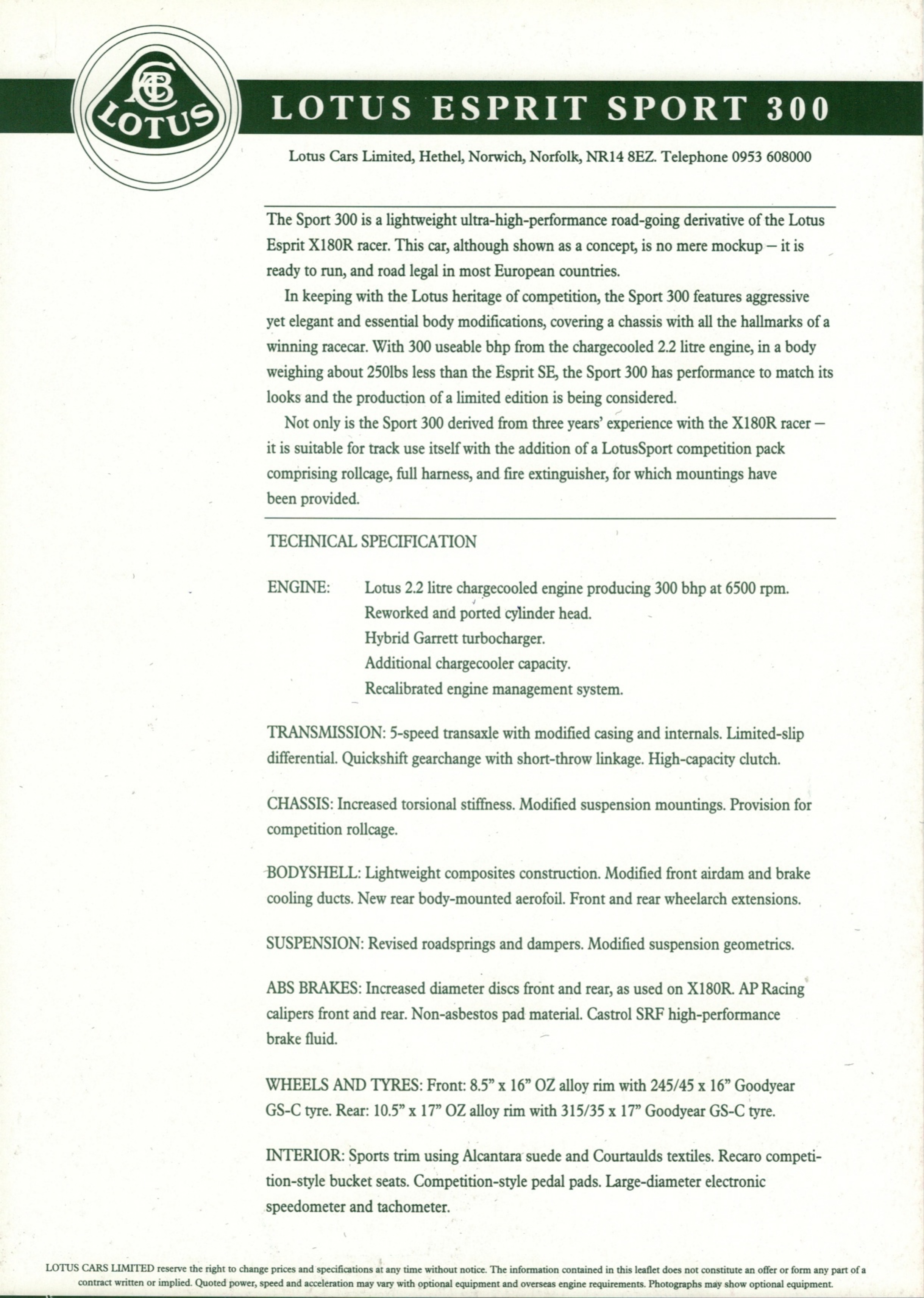
A leaflet written before the car existedOne detail sets the whole sheet in its place, and it is easy to read past. The factory writes that the Sport 300, “although shown as a concept, is no mere mockup — it is ready to run, and road legal in most European countries,” and that “the production of a limited edition is being considered.” This is not a brochure for a car on sale. It is a document produced while Lotus was still deciding whether to build one at all — a running concept being shown to a market it hoped would ask for it, in the same way, and for much the same reason, that the X180R had been shown to the European importers three years earlier. The difference is that this time the answer was yes: sixty-four cars followed.
The figures on the sheet are therefore the factory’s claims for a concept, not measurements of a delivered car — and they are not quite the numbers the car is usually credited with. The leaflet says 300 bhp; independent specification records of the production Sport 300 put it a little above, at roughly 302 bhp. Two ways of counting the same engine, three decades apart, and the gap is small enough not to matter and specific enough to be worth recording rather than averaged away.
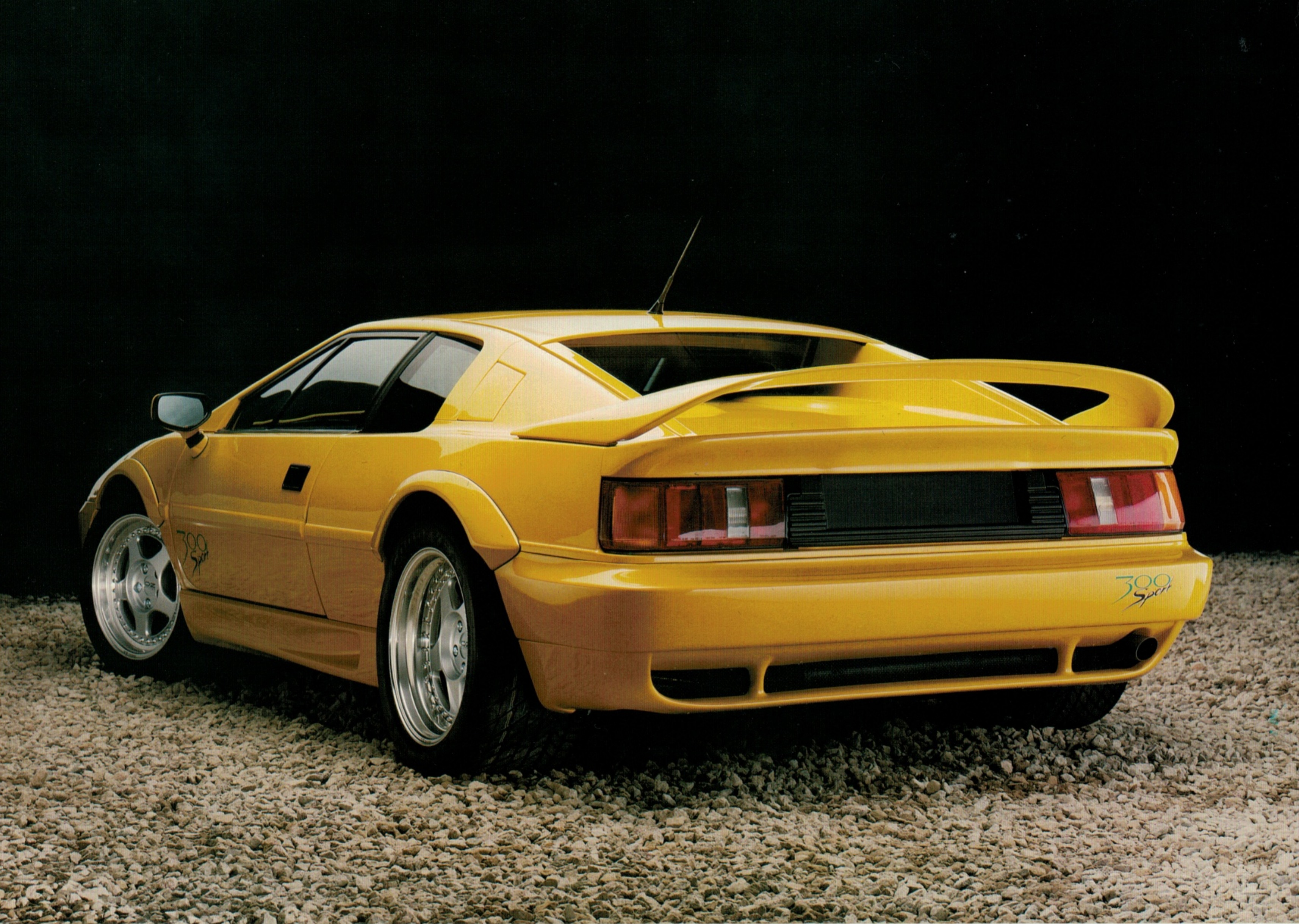
Return to the SartheHaving built a genuine competition history in America with the X180R and the Type 106, Lotus resolved to put an Esprit back on the world’s most famous endurance grid, and chose the Sport 300 as the basis for the effort. It entered a pair of Sport 300 Turbos at the 24 Hours of Le Mans in 1993 and again in 1994 — the marque’s first works-supported Le Mans presence in decades. Both campaigns were run in partnership with Hugh Chamberlain’s Chamberlain Engineering. The 1993 cars ran in the GT class as chassis numbers 44 and 45; for 1994 the team fielded cars 61 and 62, the latter driven by Richard Piper, Peter Hardman, and Olindo Iacobelli, the former by Thorkild Thyrring, Andreas Fuchs, and Klaas Zwart (per lotusespritturbo.com and the 1994 Le Mans entry lists). In race trim the four-cylinder cars were reported to be making close to 400 bhp and relied on their light weight and slippery aerodynamics to hang with far larger machinery.
“We Found Out Things About It We Didn’t Know”The 1993 effort is unusually well documented, because LotuSport’s own newsletter carried an interview with the man who ran the engines. Alan Nobbs — the Lotus Engineering powertrain engineer recruited from the Corvette ZR-1 project who had developed the Type 105 in 1990 — went to the Sarthe with a crew drawn from Hethel, and his account, printed in the fourth Race Report of July 1993, is the closest thing to a primary record of the attempt.
The preparation was compressed to the point of desperation. “A whole bunch of people worked 7-day weeks, 12 to 16-hour days, for three weeks before the event,” Nobbs said. Testing was limited by the facilities available: at Hethel the car “topped out at 150 miles an hour before braking for the corner, and at LeMans we were doing 180, so there were things we couldn’t test.” His summary of the race itself is the honest one an engineer gives when a program arrives underprepared: “LeMans was just like one big test session. Every time we ran the car we found out things about it we didn’t know.”
Nobbs also gives the engine’s true race output, which is lower than the round number usually quoted: “The engine has the potential for 400 horsepower, we raced at about 375.” Chamberlain Engineering — the outfit that had won the World Sports Car C2 division the previous year with Spice prototypes — ran cars 44 and 45 with Ferdinand De Lesseps, Olindo Jacobelli and Richard Piper in one and Peter Hardman, Thorkild Tyring and Yojiro Terada in the other. (Both drivers’ names are given differently by the two source documents cited in this section — Iacobelli/Jacobelli and Thyrring/Tyring — and both spellings are reproduced here as documented rather than normalized.) The specification Nobbs’s team ran included roof-mounted oil cooler and chargecooler, AP 13-inch vented brakes with six-piston front calipers, 18-inch OZ wheels, dry-sump oiling, a Garrett turbocharger, and a Hewland five-speed transaxle behind an AP four-plate clutch.
Heat Soak — and the Honesty About ItIn both years, success evaded Lotus for the same reason. The cars ran strongly on the circuit, but could not be cooled sufficiently during the pit stops for driver changes and tire changes; heat soak while the cars sat stationary cooked the cylinder-head gaskets, and the engines overheated. Nobbs watched it happen to both cars in sequence: “Then the head gasket went on the first car at somewhere between 8 and 9 hours. At that point we kind of knew the writing was on the wall for the other one. When it got past 12 hours, we began to think maybe it’s going to be all right. Then at close to 16 hours the same thing happened to the other one.”
His diagnosis is worth quoting exactly, because he declines to overstate it: “Heat soak was probably a contributing factor. At LeMans you have to turn the engine off in the pits, it’s the rule. But it’s a little bit of an assumption without more testing.” The heat-soak explanation, in other words, comes from the engineer who was there — offered as the likeliest cause, not a proven one, and it is not hardened here beyond what he was willing to claim.
The 1993 race was chaotic long before the gaskets went. The leading edge of car 45’s tailgate broke away on the first lap; the bonnet then departed car 44 and was returned to the pits by “some kind little French spectator” who “borrowed a bicycle, and came cycling it back to us.” Thorkild Tyring put a car into the gravel traps on the Wednesday night with a broken shock-absorber mount, filling the engine bay with stones and costing the team a night’s running; and car 45 was eventually crashed by Yojiro Terada at the first chicane on the Mulsanne after being overtaken by one of the Toyotas under braking. Neither year produced a finish (contemporary accounts also cite a suspension failure and a collision ending the 1994 run — the mechanical toll compounding the thermal one). Nobbs’s own verdict was nonetheless forward-looking: “Everybody involved was pleased with the way the cars performed. With so little time to prepare, the cars went pretty well… As soon as we iron out the few teething problems, it will be a very good race car.” The Esprit’s Le Mans chapter, like the European X180R before it, closed short of the ambition that opened it.
Source: “Lotus at LeMans — an interview with Alan Nobbs, Lotus Engineering”, LotuSport Race Report No. 4, Very Late July 1993. Pre-race entry details from LotuSport Race Report No. 2, June 1993.
The Road Not Taken
Taken together, the European pitch and the Sport 300 mark the boundaries of the X180R idea. Pushed outward as a race replica for sale abroad, it found no takers; softened into a road car and sent to Le Mans, it found no finish. What remained was the original: twenty road cars and five racers, built for one market, for one championship. The story of what became of them — the program’s wind-down, the scattering of the cars, and their eventual revival at Goodwood — is told in the Aftermath.