Part One Origins & Construction
The number twenty was not a marketing flourish or a nod to exclusivity. It was the exact figure written into a rulebook, tied to a tax deadline that fell on a single day. Understanding why Lotus built precisely twenty road-legal X180Rs — no more, no fewer, and all at once — explains nearly everything about how the car came to exist.
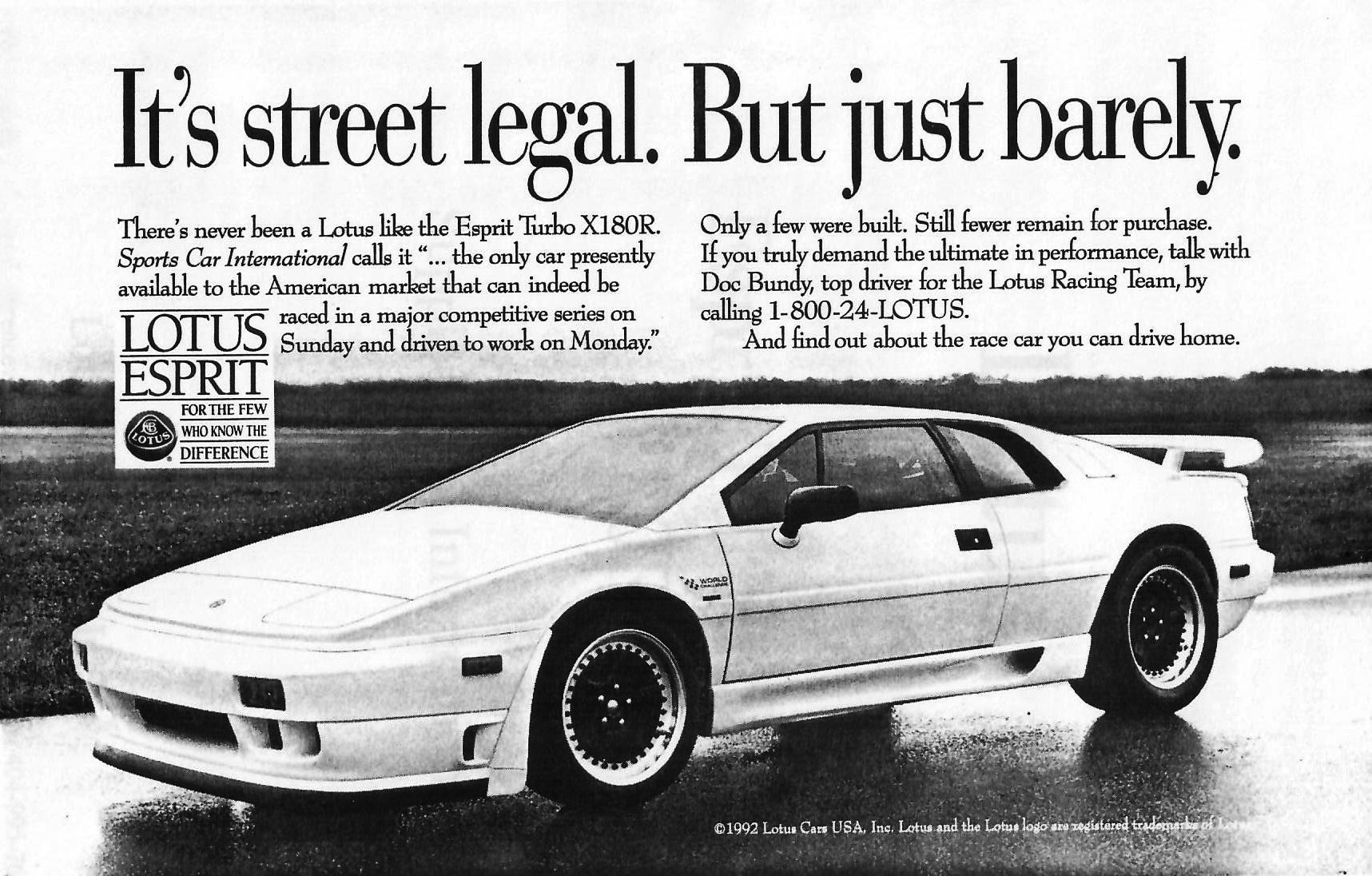
The 200-plus-20 RuleThe Type 105 had proven the Esprit could win, but it could not carry Lotus into IMSA’s new Bridgestone Potenza Supercar Championship. The problem was homologation. The Type 105 had been developed too far past anything a customer could buy — and IMSA’s Competition Rules demanded a close relationship between the race car and the showroom. Two thresholds governed eligibility. First, a manufacturer had to have produced road cars at a rate of at least 200 nearly identical units, sold in the United States — a bar the Peter Stevens-designed Esprit SE had already cleared through several years of ordinary production. Second, and decisively, the manufacturer had to build a minimum of twenty cars that shared the critical components of the car it intended to race.
The clause survives in IMSA’s own hand — reproduced verbatim at right. Article 11.8.2 of the 1994 IMSA Code sets four conditions on an eligible car: a minimum production rate, a listing in the manufacturer’s catalogs, availability for sale through its U.S. dealer network, and serial numbers correct to the model year.
Read closely, that is four separate tests, and the X180R had to pass all of them. Not merely built — cataloged, marketed, sold through dealers, and serial-numbered to the model year. It explains why Lotus could not simply construct twenty cars and park them: the rule demanded a paper trail through the American dealer network, and the twenty road cars are that paper trail. (The edition we hold is 1994; the car was homologated for 1991, and the 1991 book has not been located. The wording is quoted as the 1994 Code’s.)
That second requirement is the origin of the twenty. As LotuSport team owner Jack Ansley put it, the “IMSA series tried to do the best it could at keeping the cars relatively stock, but these were X180-R Esprits, a race-built version of the Esprit SE. Lotus produced 20 of them and sold them as street cars, the number needed in order that they’d be legal to race in the Bridgestone Series.” The road cars were not a commercial product that happened to be fast; they were the legal instrument that made the race car eligible. Lotus scrambled to produce a short run of exactly enough X180Rs to satisfy the rule for IMSA’s inaugural 1991 season.
The Deadline Written Into the RulesHomologation carried its own calendar, and it was unforgiving. IMSA required that the twenty near-identical cars be manufactured for the North American market by December 31st of the year prior to the first season in which the car would be campaigned. Miss the date and the car would sit ineligible until the following year. There was a modest cushion elsewhere in the regulations — the rulebook stated that “model variants introduced after the first race of the season will not be approved until next season,” which meant Lotus technically had until the season’s first race, at Lime Rock on May 27, 1991, to physically field the racer. But the twenty road cars themselves had a hard wall: they had to be built and landed in the United States before the end of 1990.
The Tax That Nearly Killed the ProgramA six-month development window was reasonable for a factory that already had the Type 105 in hand. The real pressure came not from IMSA but from Washington. The Omnibus Budget Reconciliation Act of 1990 introduced a new federal luxury excise tax that took effect on January 1, 1991 — 10 percent levied on the portion of a passenger car’s price exceeding $30,000. Because IMSA required all twenty homologation cars to be sold into the North American market, every one of them would land squarely in the path of the new tax if it arrived even a day late.
Oliver Winterbottom, who managed the X180R road-car project, recorded how narrow the margin was in his book A Life in Car Design – Jaguar, Lotus, TVR: “The [X180R] prototype was finished in late October 1990, and all the cars needed to be landed in the USA before the end of the year, to avoid the forthcoming luxury tax. We just managed it.”
The size of the penalty is easy to overstate. The tax applied only to the amount above the $30,000 threshold, not to the full sticker. On an X180R priced near $126,000, that worked out to roughly 10 percent of $96,000 — on the order of $9,600 in additional cost per car (closer to $9,800 against the ~$128,000 as-sold figure some cars carried). It was a meaningful sum on twenty cars, and enough to threaten the viability of selling an already-expensive niche model. Had the shipment slipped into January, the added cost could well have pushed the X180R past the point where Lotus Cars USA could move the cars at all, and with them the entire IMSA program.
Why All at OnceThe homologation logic also answers a question that would otherwise look like a manufacturing gamble: why build a full run of twenty specialized cars in one batch rather than waiting for customers to order them? Because the rule and the tax both demanded it. The cars had to exist, in North America, as finished and sold vehicles before December 31, 1990. There was no time to test the market, take deposits, and build to demand. Lotus committed to the whole run up front and worried about selling them afterward — which is precisely why a handful still sat unsold on dealer floors into 1992.
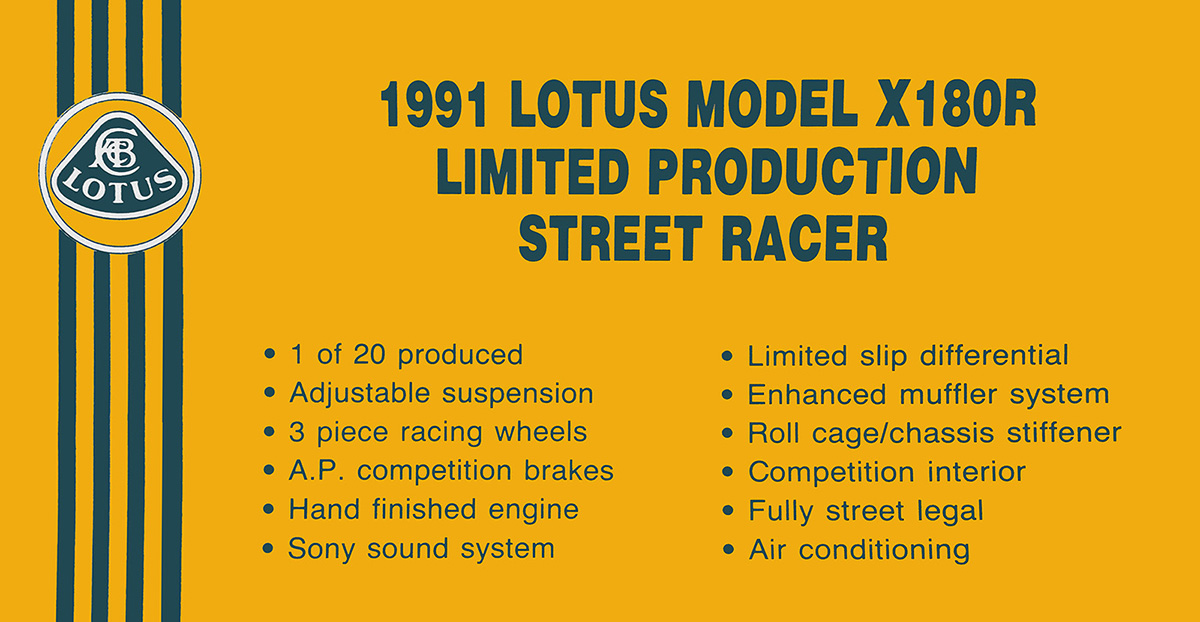
Selling a Race Car to Luxury BuyersThat left Lotus with a genuine marketing problem. The Esprit’s North American buyers were accustomed to a high-performance luxury sports car — leather, comfort, refinement. The X180R was, by design, a stripped and caged racer with a nomex-like “doeskin” interior, priced at an MSRP of $126,000 in 1991 (roughly $300,000 in 2025 dollars). How do you explain such a departure to that audience?
The answer came from the previous season’s success. Coming off the Type 105’s strong debut in SCCA World Challenge, Lotus marketing settled on a name that framed the strange, race-bred Esprit as a trophy rather than a compromise: the World Challenge edition. The branding was carried onto the car itself, with the “World Challenge” flag logo applied to the front fenders — a period reference to a championship the road-car buyer could feel they were buying into. Internally, the engineering team used a blunter description for the same object: the “World Challenge Race Car Replica.”
What Winterbottom Left OffEven the specification reflected the tension between race intent and road legality. Winterbottom specified several items that were then deleted before the twenty cars were assembled, including racing seat belts — which the NHTSA would not have approved for road use in the United States — and an oil pan baffle. The car was to be as close to the racer as the law would permit, and no closer.
With the rule satisfied, the tax dodged, and the marketing story in place, the remaining question was purely one of engineering: how do you turn an Esprit SE into a car stiff enough, light enough, and fast enough to homologate a championship contender — and still register it for the street? That work happened at Hethel, and it is the subject of the next chapter, Building the Car at Hethel.