Part Two Competition
The homologation run bought Lotus a seat at the table; the Type 106 is what it brought to the fight. Built from the road-legal X180R exactly as IMSA’s rules demanded, then developed as hard as those rules allowed, the Type 106 carried Lotus through five seasons of the International Motor Sports Association’s Bridgestone Potenza Supercar Championship — a televised, factory-versus-factory sprint series that pitted the four-cylinder Esprit against Porsche’s twin-turbo flat-six and Chevrolet’s V8. Over 1990 through 1995 the X180R took a drivers’ title, runner-up in the manufacturers’ standings in both its SCCA World Challenge seasons (1990 and 1991) and both full IMSA Supercar seasons (1992 and 1993), and enough poles and wins to make the German cars work for everything they won.
This chapter follows the race car and its seasons; the results tables live on each year’s page — 1991, 1992, 1993, 1994, and 1995 — and are linked as each season is discussed.
The Series
A Televised Sprint for Street-Legal SupercarsFor the 1991 season IMSA launched the Bridgestone Potenza Supercar Championship, a professional series built on rules very close to the SCCA World Challenge in which the Esprit had already proven itself, but with a far larger stage. The premise was straightforward and marketable: take genuinely street-legal exotics — the field ranged from the Porsche 944 upward, with the most extreme homologation specials such as the Ferrari F40 and Porsche 959 excluded — strip only what safety and the rulebook permitted, and race them wheel-to-wheel in short, sharp events run in support of IMSA’s prestige Camel GT/GTP races. Eligibility rested on production: a manufacturer had to build at least 200 nearly identical cars over a twelve-month period, marketed through its US dealer network, before it could campaign a car. The prize fund for the inaugural 1991 season was substantial — $375,000 — and, crucially for the manufacturers footing the bills, the racing was televised.
Thirty Minutes, Flat OutThe format rewarded aggression. Looking back at the series in 2009, LotuSport owner Jack Ansley recalled the character of the racing without nostalgia softening it:
These were incredible races. I’ve seen a lot of races in my time, and this series was some of the best, most intense, most competitive racing that I’ve ever witnessed, or that anyone has. It was a support series with an amazing level of driving talent spread among factory programs from Lotus, Porsche and Chevrolet. And most of these races were only 30 minutes long, with almost every one a flat-out, flag-to-flag sprint.
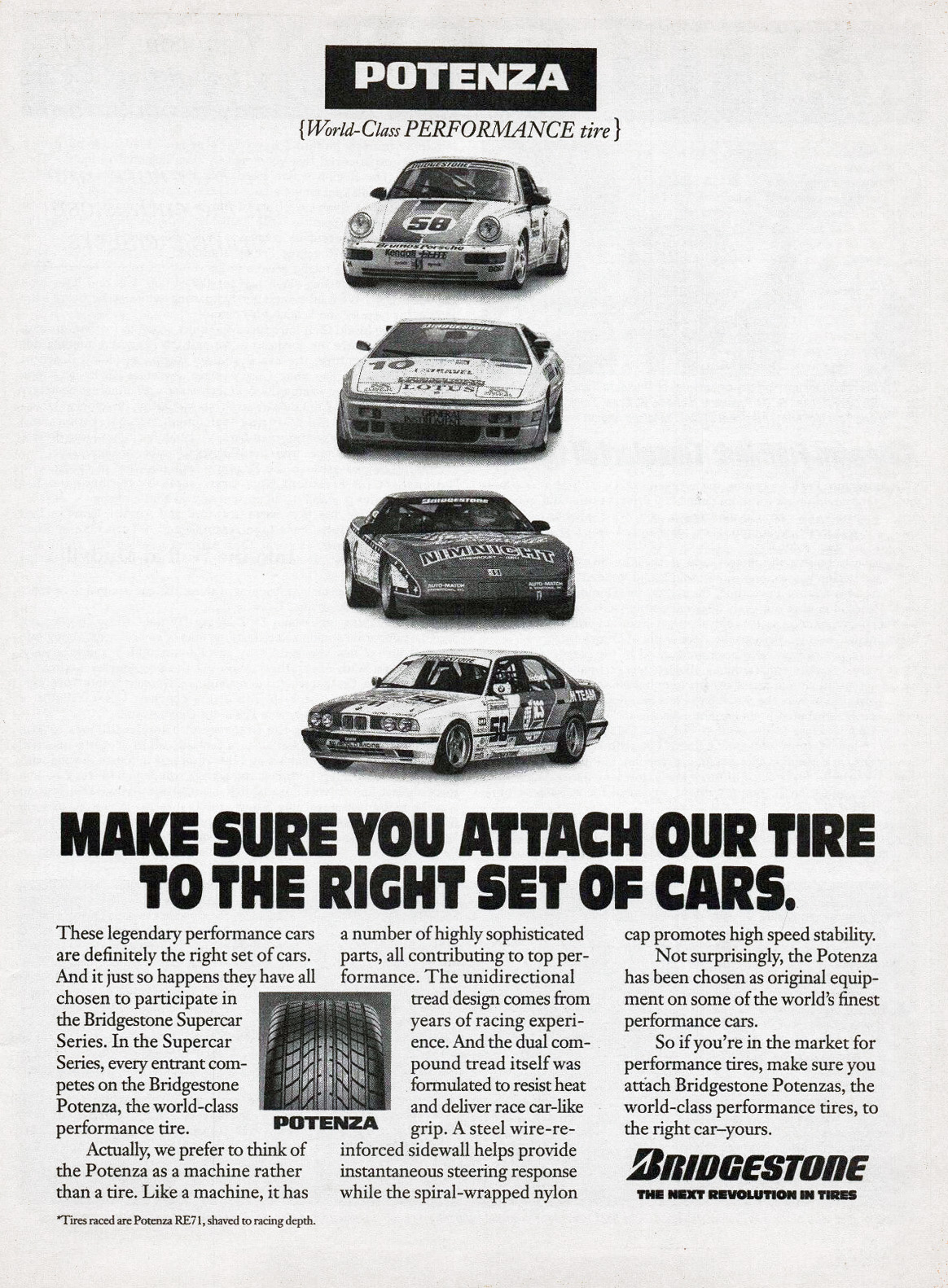
As the Bridgestone name on the series suggested, every car ran on shaved-down street-legal Bridgestone Potenza RE71 tires, trimmed to semi-racing depth — full-depth RE71s were permitted only in the wet. IMSA allowed the catalytic converters to be removed and replaced with straight pipes, a concession that had less to do with power than with spectacle, ensuring the crowd heard the engines as they were meant to sound.
Racing Within the RulesThe engineering freedoms were deliberately narrow. Engines had to remain standard, though IMSA permitted blueprinting — the precise machining and assembly that extracts power and reliability without altering the specification. Manufacturers could delete the roll cage, fuel cell, harness, window net, and fire extinguisher for the road cars, and shock absorbers could be substituted provided they were interchangeable with the originals without modification. Wheels had to be as delivered, a constraint that would loosen for Lotus in 1992 when the team was allowed to fit 17-inch rears. The central lever IMSA reserved for itself was weight: to keep the field close, the sanctioning body raised a car’s minimum weight as it won, a handicap that would come to define — and eventually end — the Esprit’s competitiveness.
Building the Type 106
From Homologation Car to Race CarThe Type 105 had won in the SCCA World Challenge, but it was too far removed from any Esprit that Lotus sold to the public to satisfy IMSA’s homologation officials. The answer was the road-legal X180R and, built from it, the more highly developed Type 106 — the car that would actually contest the Bridgestone Supercar Championship. Because IMSA’s rules demanded minimal deviation from the production model, the Type 106 remained recognizably an X180R. Where it differed, it did so within the letter of the regulations. The most significant change was structural: in place of the road car’s RAC-approved cage, the Type 106 carried a more complex, FIA-approved roll cage, strengthening the shell for competition. The rules’ allowance for 17-inch rear wheels was taken up. And more power was found where the rulebook permitted — through larger fuel injectors drawn from the Lotus Carlton, the four-door super-saloon Lotus had engineered around the same period.
The Grunt of the Turbocharged FourThe Esprit’s decisive weapon was boost. The homologation car left the factory with an advertised 286 hp; under race preparation, the Type 910S four-cylinder gave far more. According to Jack Ansley, whose LotuSport team built and ran the engines:
[The X180R had] an advertised 285hp to start with from the factory. Remember, though, we were looking at being competitive with Porsche, which was running the 911 Turbo. We were limited under the rules to stock boost pressure, but we still managed to routinely get 450hp out of the engines. I think the most we ever got in a dyno test was around 525hp, just trying to see what it could take. That’s from a 2.2-liter four that was rated at 160hp before it was turbocharged. Race days, we were generally running 450 to 475hp, in a car that we got into the 1,900s, weight-wise.
That a 2,174 cc four, rated at 160 hp in naturally aspirated form, could be coaxed to a dyno figure north of 500 hp under a stock-boost rule tells much about how hard the Garrett-fed, chargecooled engine was working — and why IMSA kept reaching for the ballast.
The Neon WarpaintThe Type 106’s most recognizable feature was not, strictly, a performance part at all. Midway through the 1991 season the cars acquired the multi-color neon identification decals — on the mirrors, a stripe across the windshield header, and the rear wing — that became the visual signature of the program. The idea was Doc Bundy’s, conceived for the practical reason that a field of near-identical Monaco White Esprits was hard to tell apart at speed; the neon made each car legible to timekeepers, television, and spectators alike.
The Team and Its Drivers
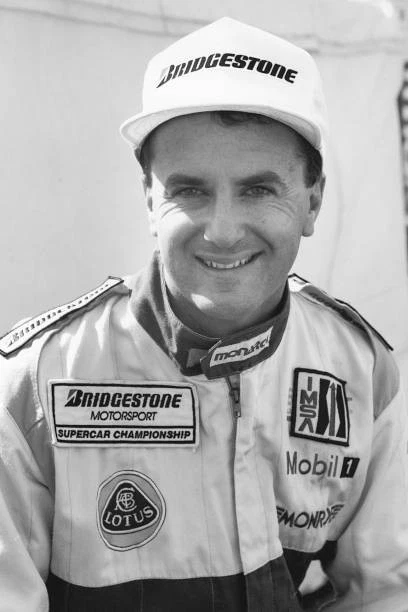
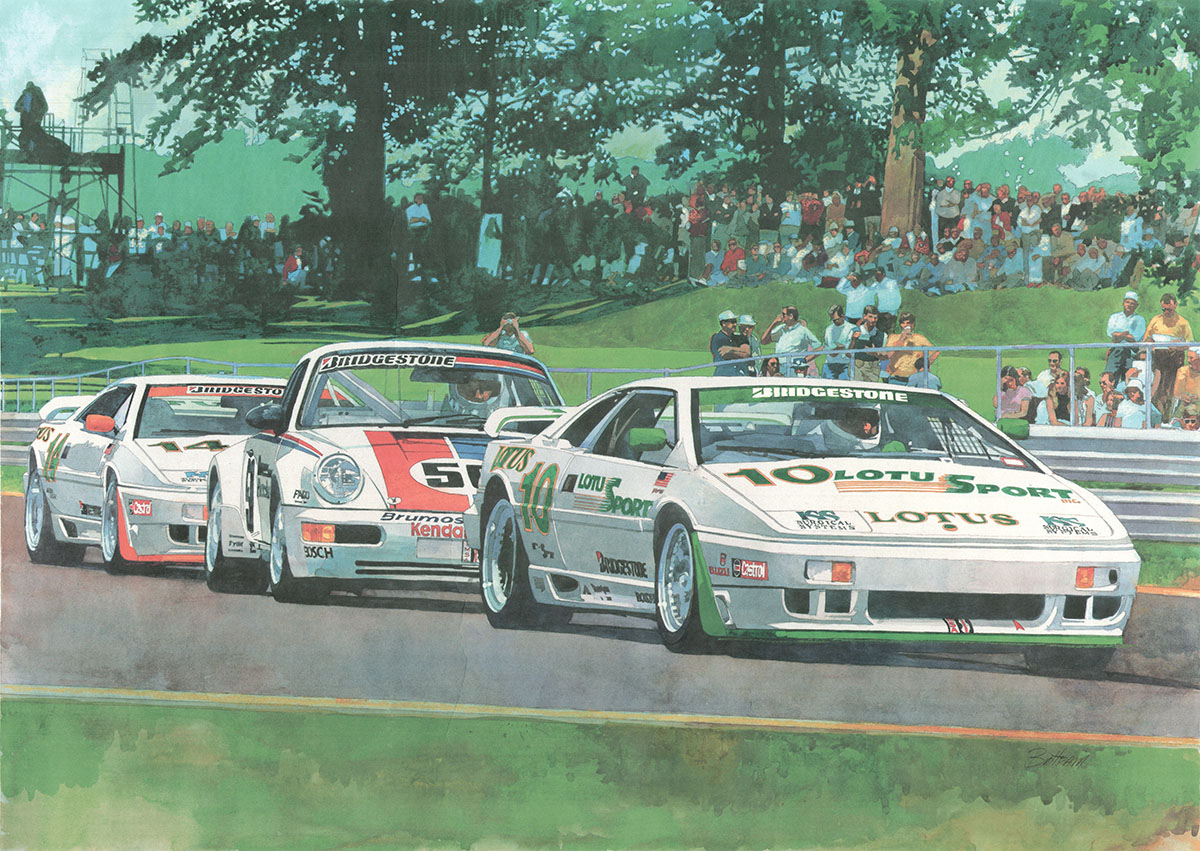
LotuSportTo campaign against the factory-backed programs of Porsche, Mazda, and Chevrolet, Lotus established LotuSport under Jack Ansley, who had run the Pure Sports operation that developed the Type 105. The driving strength was led by Doc Bundy — the man who had pitched Lotus on racing in America in the first place — supported across the seasons by David Murry, Michael Brockman, Andy Pilgrim, Scott Lagasse, Bo Lemler, Bobby Carradine, and others. The Esprit X180R would become Lotus’s most successful factory-built road racing car since Team Lotus’s Formula One domination of 1978 with the Lotus 78 and 79.
Paul NewmanAny winning factory team draws publicity, but LotuSport gained an unusual measure of it through an occasional driver: the actor Paul Newman, an accomplished racer and Indy Car team owner who had been competing in SCCA and IMSA machinery since the early 1970s. The connection ran through the team. As Ansley recalled, driver Michael Brockman “was good friends with Paul Newman, was kind of my source to get Paul onto our team… Mike commonly used the American flag windshield tint on his Lotus, to distinguish him from our other drivers.” Newman raced the X180R in period, including a fifth place at Road Atlanta in the title-winning 1992 season.
The Riddle of the Car NumbersSome confusion about the cars’ race numbers has persisted, and it is worth stating plainly what is known. The LotuSport Esprits were generally numbered 9 through 12, with a 14 appearing in 1992 and 1993. Doc Bundy did not always drive the same physical chassis, but whichever car he raced carried number 10; Michael Brockman ran under 11 or 12. The reason the numbers floated between cars was IMSA’s weight rule: because ballast was assigned to an individual chassis after that chassis won, the team would move its lead drivers into whichever car carried the lighter penalty, and the number followed the driver rather than the shell. The result is that a given number does not reliably track a single Type 106 across the seasons — a detail that has confounded later attempts to trace individual cars by their race numbers alone.
The Seasons
1991 — A Late, Partial EntryLotus contested only the final three IMSA Supercar rounds of the inaugural season, having spent the first half of the year concentrating on its SCCA World Challenge campaign, and even those three came late. The record from this abbreviated entry was nonetheless emphatic: Doc Bundy won first time out at Road Atlanta on September 1, and across the three IMSA rounds the team put at least one car on the podium — often two or three — every time it entered. Bobby Carradine took second at both Road America and Del Mar. It was a statement of intent rather than a title bid; running only the last three of the season’s races left Lotus no path to the 1991 championship, which went to Porsche.
1992 — The Championship YearThe high point of the entire program came in the first full Bridgestone Supercar season Lotus contested. Doc Bundy won the Drivers’ Championship — the last major racing title Lotus would win. The season’s shape was one of relentless podium presence: LotuSport recorded three wins and stood on the podium in seven of the eight races, Bundy winning at Road Atlanta, Portland, and Phoenix, with David Murry, Andy Pilgrim, and the rest of the roster filling out the rostrum behind him. The exact final points tally for the 1992 championship is not reproduced here; the researched season standings belong on the 1992 season page.
Lotus did not, as this chapter and most accounts of the car long maintained, also take the 1992 Manufacturers’ title. No document produced by the team or by Lotus Cars USA claims it, and Doc Bundy — the reigning Drivers’ Champion — described that title as LotuSport’s “goal” for the following season. The correction, and the evidence behind it, is set out on the 1992 season page.
It was during this season that IMSA and rival teams protested that the X180R had strayed from its production specification — a challenge Ansley met by pointing out that the cars entered were “1992 model X180Rs,” a variant running turbocharger part number 525.4021.603AF. The dispute foreshadowed a sharper one to come.
1993 — Second, and the Lime Rock ProtestUnder a minimum weight raised 125 pounds to 2,700, Lotus opened the season by sweeping the podium at Miami — Bundy, Pilgrim, and Murry across the top three — and Murry led every lap at Atlanta for his first Supercar win. But the title slipped away over the year to Porsche’s Hans Stuck, and Lotus finished a close second in the Manufacturers’ standings. The season turned on the incident at Lime Rock on May 31, where David Murry finished third on the road and was disqualified that evening after IMSA ruled his car carried the wrong turbocharger. The turbocharger in question, Group Lotus part number 525.4021.603AF, was the correct unit for the 1992-model X180R — the specification under which every LotuSport car had been entered since the start of the 1992 season, as Jack Ansley’s appeal to the IMSA commissioner set out point by point. The appeal failed, and the protest carried a particular irony, given that it was Porsche and its supporters raising the objection against a Lotus turbo, when the Porsche entry’s own homologation had rested on a delicate reading of what its cars were “as delivered.” That parallel is taken up in the next chapter.
The Turbo Lotus Was Made to RunThe consequence of the Lime Rock ruling mattered more than the lost podium. From Watkins Glen onward LotuSport was obliged to fit the 1991-specification Esprit SE turbocharger in place of the 1992 X180R unit — a smaller turbo that cut torque on circuits that demanded it, and which, by the team’s reckoning in its third Race Report, left the Esprits “100 to 200 hp less than Porsche and Pontiac while carrying over 200 lbs. of lead.” Writing in his own column in the same issue, Doc Bundy recorded the detail that gives the episode its edge — that the part IMSA had obliged Lotus to run was one its own manufacturer advised against:
So, that’s where we are, pedaling our backsides off with a turbo not designed for these conditions (not recommended by either Lotus or Garrett — the turbo manufacturer), trying to extract every ounce of performance we can to make up for the 200-plus horsepower advantage of Porsche and now Pontiac. This has become one looong uphill climb lately and, with IMSA wearing these blinders, the likelihood of us becoming competitive again in this series seems unlikely.
That a factory driver in the reigning champion’s seat would put that in print, over his own name, in a newsletter sent to the team’s own customers, is the clearest surviving measure of how far the balance had moved. The full season, race by race, is drawn from those six LotuSport Race Reports.
1994 — Ballast and Diminishing ReturnsFor 1994 IMSA raised the X180R’s minimum weight another 100 pounds to 2,800, against 3,200 for the Porsche Turbo S2 — a differential that, on paper, still favored the light Lotus, but the cumulative penalties were steadily eroding the car’s edge. The season was one of hard-won podiums rather than titles: Andy Pilgrim scored the year’s single win at Phoenix, and the team gathered seven podiums across the eight rounds, but Lotus finished third in the Manufacturers’ Championship behind BMW and Nissan. The Esprit also stretched its legs in endurance company that year, Bundy and Murry taking a Lotus Cars USA-entered car to a class result at the 12 Hours of Sebring.
The rulebook’s own account of the ballastThe weight was not improvised race by race, and the 1994 Code says how it worked. Article 11.8.4 gives IMSA the power to “determine and publish an official minimum weight for each eligible make and model,” measured without driver or fuel aboard; ballast, where required, “must be bolted or welded to the chassis of the automobile”; and adjustments come “in a maximum of 50 lb increments.” The published table for 1994 sets the Esprit at 2,800 lb and the Porsche 911 Turbo S2 at 3,200 — confirming, from the sanctioning body’s own paper, the four-hundred-pound margin this chapter has been describing.
And the turbo war ends in the rulebookThe argument that ran through 1993 — over what Lotus and Porsche were doing with their turbochargers, and over the Lime Rock disqualification — has a quiet epilogue in Article 11.8.6.r. By 1994, every turbocharged or supercharged Supercar had to carry an AN-4 fitting on the intake manifold and a 5/8-inch hole drilled through the firewall, so that an IMSA-supplied boost recorder could be mounted in the cabin and hosed to the engine. IMSA would set maximum boost “based on manufacturer specifications,” and could make a competitor buy or lease the recorder from IMSA itself.
Two seasons of teams insisting their boost was legal ended with the sanctioning body declining to take anyone’s word for it. From 1994 the rulebook simply measured.
1995 — The Program EndsThe end came midway through 1995. Changes to IMSA’s rules and, decisively, the loss of Lotus factory support prompted LotuSport to shut the racing program down partway through the year. The cumulative weight penalties had by then made the chassis uncompetitive; the car that had once run in the 1,900s was carrying the ballast of every win it had ever scored. Andy Pilgrim managed a podium and a pole in the abbreviated campaign before the team wound down — Pilgrim finishing the year in a Pontiac Firebird Firehawk, and Bundy contesting one final Supercar race in a Nissan 300ZX Turbo. After five seasons, the factory Esprit’s front-line racing career was over.
The Ledger
A Career in NumbersAcross 1990–1995 the X180R’s factory record stands at one overall Drivers’ Title (the 1992 IMSA Bridgestone Supercar season) and four second-place Manufacturers’ finishes — both SCCA World Challenge seasons (1990 and 1991) and both full IMSA Bridgestone Supercar seasons (1992 and 1993) — together with 15 wins, 16 poles, and 47 podium finishes (counted per car) across the 57 races on record.
IMSA’s weight-handicapping tells the counter-story in a single column — the minimum climbing from the 2,575 pounds of 1992 to 2,700 in 1993 and 2,800 in 1994, each increment a tax levied on the car’s own speed. The Bridgestone Supercar series was explicitly designed to normalize performance and keep the field close, and by that measure it worked: the Esprit remained competitive enough to keep taking poles and wins to the end, even as outright championships slipped beyond reach.
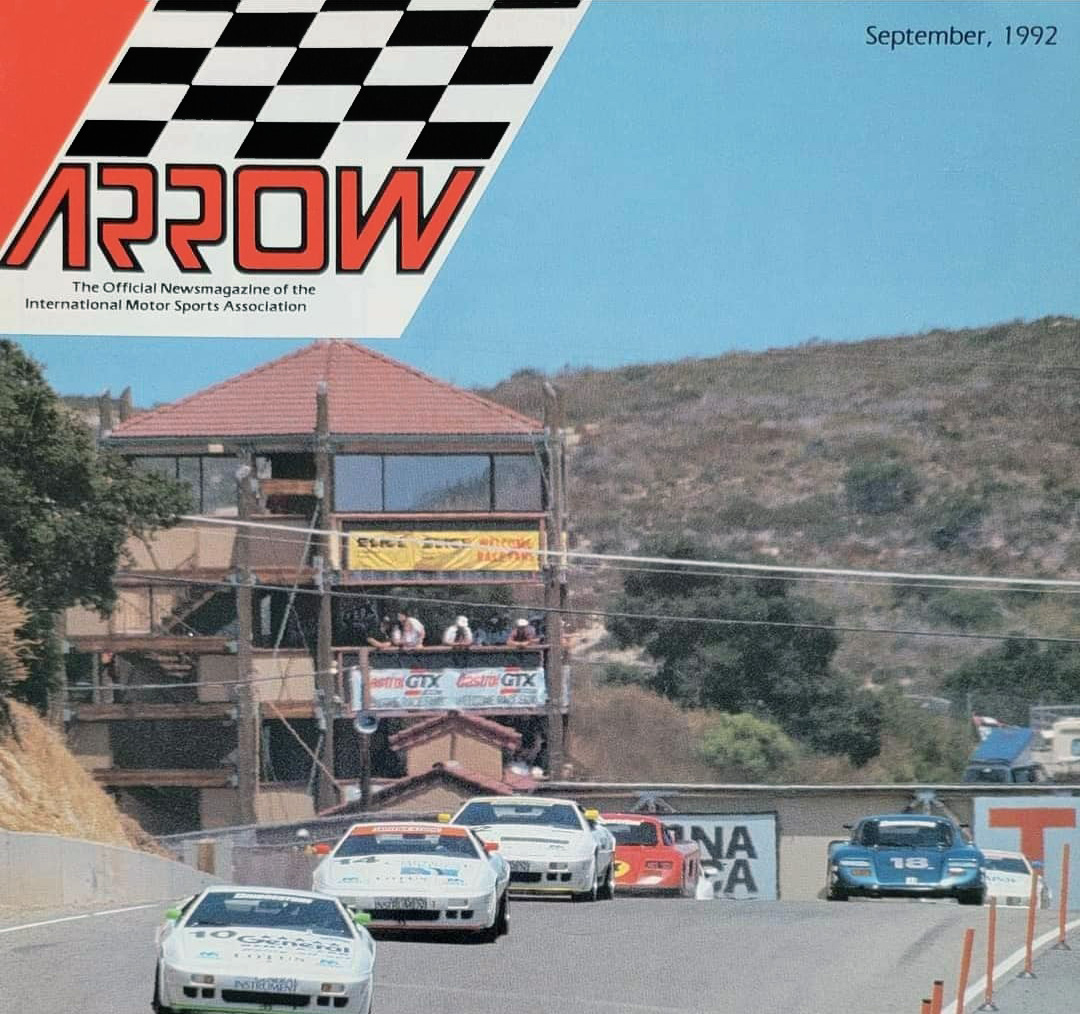
The Rival That Set the TermsEvery figure in that ledger was shaped by the car in the other garage. Lotus was not the only manufacturer to build exactly twenty homologation cars for the Bridgestone Supercar Championship — Porsche did the same, and its 964 Turbo S2 took the inaugural 1991 title and the 1993 crown, with Hurley Haywood and Hans Stuck doing the driving. How Porsche threaded its own car through IMSA’s homologation rules — importing the cars minimally prepared and finishing them stateside through ANDIAL to clear the EPA, and leaning on a single letter of Monroney-sticker notation — is a study in reading a rulebook as closely as Lotus read it, and it is the subject of the next chapter: The Rival: Porsche 964 Turbo S2.