Part One Origins & Construction
Before there was a road car, there was a race car. The Esprit X180R began not as a limited-edition road model but as an internal engineering exercise designated the Type 105 — two production Esprit SEs, pulled from the Hethel assembly line and rebuilt to chase Chevrolet’s Corvettes in a new American professional series. This is the story of how a company built on Colin Chapman’s obsession with lightness turned a luxury sports car into a winner, and why that single 1990 season made everything that followed possible.
From Corvette Challenge to World Challenge
The opening the Esprit needed came from a change in the American club-racing rulebook. Through 1988 and 1989 the Sports Car Club of America had run the Corvette Challenge, a single-marque spec series in which identically prepared C4 Corvettes raced for a substantial purse — a formula that guaranteed close racing but shut out every other manufacturer. When that series wound down, SCCA reorganized its professional production-car racing for 1990 under a new banner: the Escort World Challenge. The rules were reworked along the lines of European Group A, opening the grid to a broad field of production-based sports cars with only a limited set of permitted modifications. (SCCA Pro Racing / World Challenge series history.)
The Corvette teams did not disappear; they carried their expertise straight into the new championship. Chevrolet supported both the series and its dealer-backed racers with a run of purpose-built RPO R9G Corvettes, and the paddock assumed the outcome was a formality. As the site’s 1990 season page records, it was widely “thought that the Corvette would be unbeatable, as the Corvette Challenge series ended and numerous well-prepared Corvette teams moved over to World Challenge.” That assumption is what makes the season that followed worth telling.
Doc Bundy’s Pitch
The idea of putting an Esprit on that grid belonged to a driver. Racing driver Doc Bundy pitched Lotus on entering the SCCA World Challenge as a way to promote the marque’s high-performance cars in North America and to measure the Esprit directly against its rivals. He arrived with a credential that mattered. As David Murry, one of the LotuSport team drivers, recalled: “Doc was on the Corvette GTP team with Hendrick Motorsports, and they had a Lotus active suspension on that car. When that whole program went away, Doc went to Lotus in England and said you guys need to showcase your actual street cars in a race series.”
Lotus Cars Ltd and its North American branch, Lotus Cars USA, agreed — though the decision carried real risk. A high-profile racing effort that failed could damage the very sales it was meant to build, and the burden of making sure it did not fall on the factory’s engineers. Serious, factory-grade development of the Esprit was the only way to keep a promotional gamble from becoming an embarrassment.
The Type 105 Takes Shape
For a company founded on Chapman’s engineering and his enthusiasm for racing, the plan came together fast. Lotus pulled two Esprit SEs from the assembly line and sent them to Lotus Engineering, taking the internal Esprit designation X180 and appending R for racing. Internally the racing model was designated the Type 105. The Esprit had never been conceived as a racing car, but the groundwork existed. Roger Becker, Lotus development engineer and test driver, remembered that the initial planning for the Type 105 specification took “about a week, but we had a lot of parts in place from our lightweight programme and our office [did] know an awful lot about the Esprit chassis.” Becker had long wanted to build a lightweight Esprit capable of fighting Porsche’s 911, so when the Type 105 received the green light, much of the thinking was already done.
The central objective was weight. The team dropped the stock Turbo SE’s 2,907 lb (1,319 kg) to roughly 2,500 lb (1,134 kg) in Type 105 specification while raising output from 264 hp to 285 hp. The engineering “why” was pure Chapman. His mantra — “adding power makes you faster on the straights, subtracting weight makes you faster everywhere” — governed the whole exercise, and anything not essential to going around a circuit came out: side glass, third brake lights, electric window assemblies, the heater and air-conditioning system, and the interior trim.
The engineBecker described a neat piece of packaging that turned a deletion into a gain: “We took the air conditioning out, but took advantage of the condensor to plumb up extra direct-feed capacity for the standard chargecooling. This allowed us transient horsepower readings in the region of 300 bhp and the motor proved absolutely reliable at 7,000 rpm. The only engine trouble we ever had followed accident damage and loss of lubricant.” Freeing the air-conditioning condenser to feed the chargecooler — the Esprit’s charge-cooling system, not a conventional intercooler — gave the four-cylinder cool, dense intake air without any additional hardware.
The peopleOnce the first Type 105 was running, Lotus engineer and former Team Lotus Formula 1 driver John Miles led much of its development, including testing the ABS system at GM’s Milford Proving Ground in Michigan; most of the on-track development work, however, was carried out by the Pure Sports team that would campaign the cars. Other Lotus personnel included former TWR mechanic Colin Marriott and transmission specialist Alan Nobbs, the latter hired from the Corvette ZR-1 project. The Texas-based Pure Sports operation ran the entries under team manager Rick Adley and crew chief Jim Bell, with Ron Foster as president of Lotus Cars USA.
The specificationThe Type 105 was developed from the production Esprit with the following changes:
- Lotus Excel-type front spoiler
- Glass sunroof replaced with a fixed panel
- Plexiglass side windows
- Removal of all interior trim, sound deadening, AC/heating, and spare wheel
- Original wire loom replaced with a simpler loom
- Chassis left ungalvanized (unlike road cars), saving 17.6 lb (8 kg)
- Thinner fiberglass panels (doors, roof, bonnet, and engine decklid)
- Balanced and blueprinted engine
- Removal of the high-pressure fuel pump
- Larger injectors to increase fuel delivery
- Re-programmed ECM
- External oil pump and transmission oil cooler added in the rear valence
- All emissions equipment removed (exhaust diameter and routing retained)
- Open-pipe exhaust in place of the catalyst and muffler
- Six-point roll cage, fitted to the suspension towers and to the frame behind the seats
- Ride height lowered 20 mm
- Limited-slip differential
- Stiffer springs (50% front, 25% rear)
- Specially tuned Monroe shocks
- Stiffer bushings
- Revolution three-piece wheels (8½ × 16 front; 9½ × 16 rear)
- Goodyear Eagle “S” tires (225/50ZR16 front, 255/50ZR16 rear)
- Braking system replaced with AP Racing 13-inch (front) and 12-inch (rear) discs from the Lotus Carlton
- Four-piston alloy calipers
- Extra brake-cooling ducts
The Rules That Shaped the Car
World Challenge was a production-based formula, and its regulations dictated much of the Type 105’s hardware. Manufacturers could add parts to a car provided each carried an official manufacturer part number — the mechanism by which Lotus fitted the front-spoiler lip extension and, more importantly, the far larger disc brakes from the Lotus Carlton/Omega four-door sedan. Beyond that, the permitted modifications for the Turbo SE were narrow:
- Wheel width could change (diameter had to remain the same)
- A three-foot exhaust on the Type 105
- Minor suspension tuning (allowed)
The rules also permitted the use of future production options, and Lotus used that clause to its advantage. The three-channel ABS system on the race cars was the same system Lotus was developing for Delco Moraine to manufacture for the 1991 Esprit SE — homologated by its forthcoming appearance on a road car. Lotus treated the series as a rolling test bed for it: at Laguna Seca one Type 105 ran the new Lotus-designed ABS while the sister car ran without, the ABS car outperformed the other, and from Road Atlanta onward both cars carried the system.
A Season That Surprised Everyone
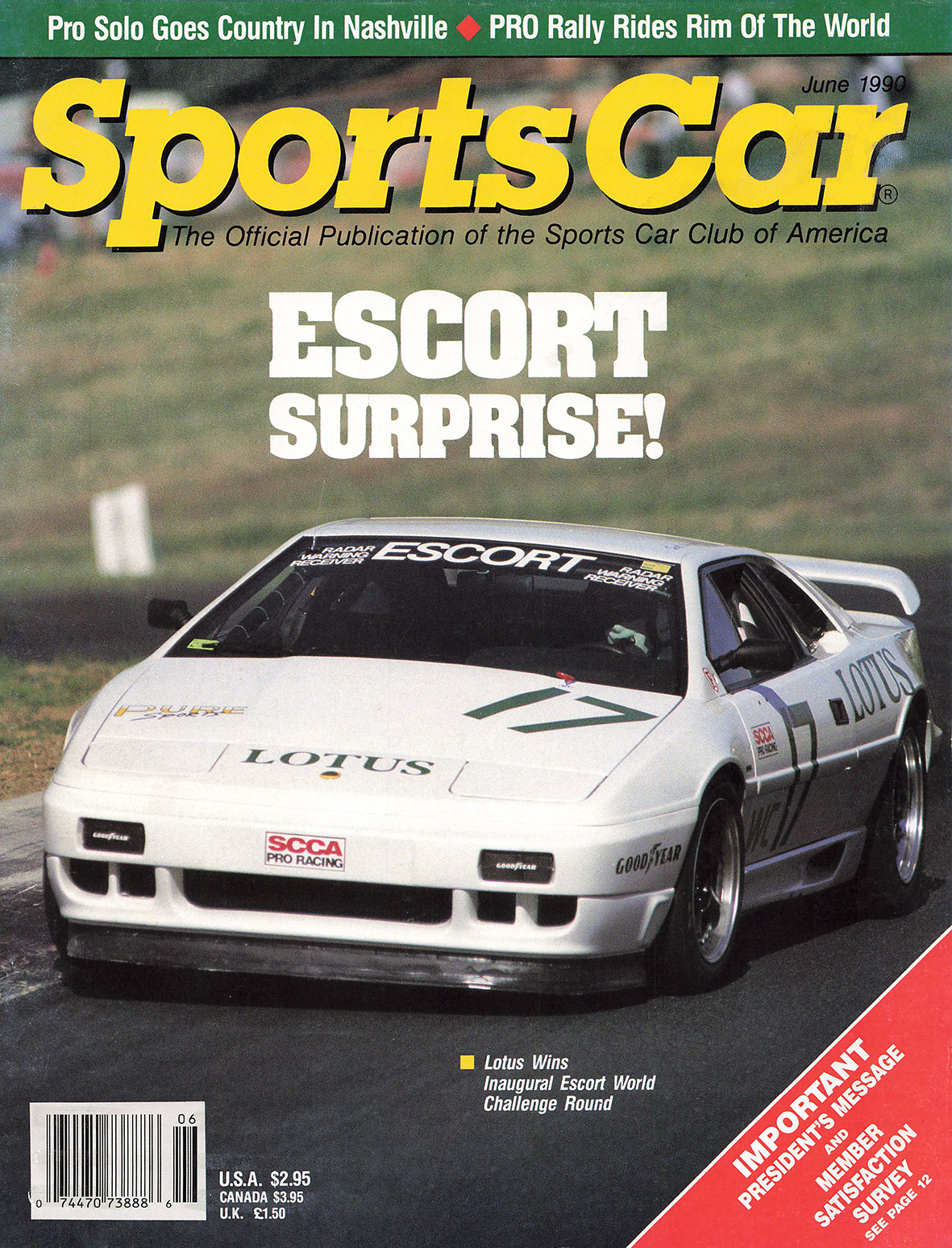
Entered under the plain description “Lotus Esprit Turbo,” the Type 105 was immediately competitive. It won its very first race — the three-hour Sears Point round on May 5, 1990 — startling a paddock that had expected a Corvette walkover and earning the Esprit the cover of SCCA’s magazine. Because the series used a weight-handicap system, the Lotus’s minimum weight was raised after successive wins, a foreshadowing of the far heavier penalties that would later define its IMSA career.
Across the eight-race season, the duo of Doc Bundy and Scott Lagasse took 6 poles and won 4 of the 8 races. A crash at Dallas — the second round of the eight, on June 3 — cost Bundy the points he needed to clinch the title; he finished second in the Drivers’ Championship, with Lagasse fifth — and every other driver in the top nine campaigning a Corvette. Oliver Winterbottom, who would go on to manage the road-car project, summarized the campaign in the letter later bound into every X180R owner’s handbook: “In 8 races, Lotus achieved 4 victories, including 2 first and seconds, 6 pole positions, 6 fastest laps and 7 race lead positions. The total race mileage of 2,900 miles was covered with 100% reliability.”1 (See the full 1990 season results for every race, grid, and points table, and the reprinted Winterbottom letter.)
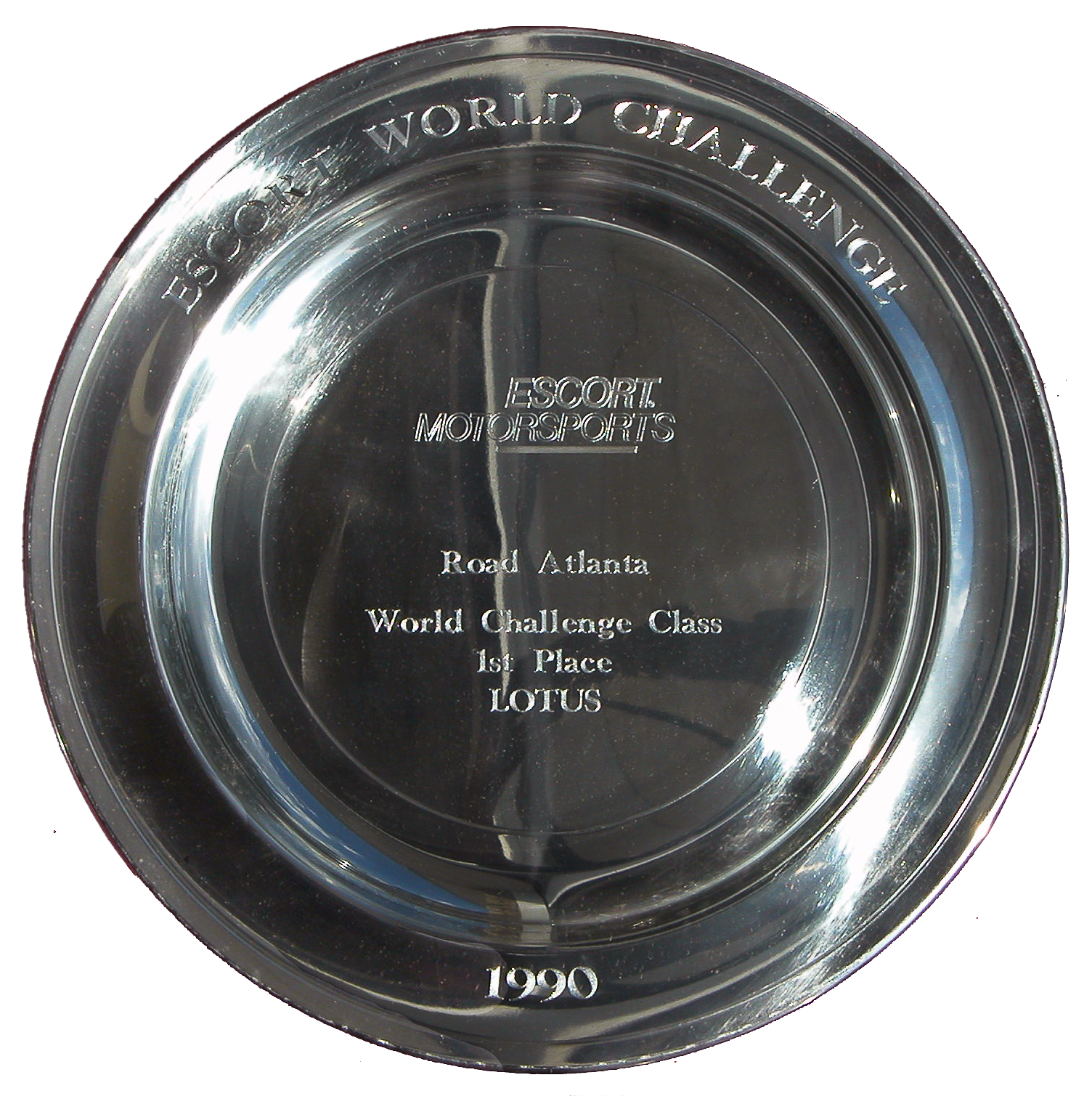
Lotus placed second in the Manufacturers’ Championship — behind the sheer numbers of the Corvette teams but ahead of Porsche, Mazda, and Nissan — and Lotus Cars USA received the Jim Cook Memorial Award for its “consistent display of good character and sportsmanship” and its “significant contribution to the overall success of the series.” For a car that had never been meant to race, against a field built to win, it was an emphatic result.
From Race Car to Road Car
The 1990 season gave Lotus both a marketing story and an engineering foundation. To celebrate the US racing success — and, crucially, to homologate the aerodynamic parts it wanted for the 1991 season — the factory decided to build a handful of road-going Esprits nearly identical to the race cars, adding back only the minimum comforts required for street registration: sport seats, glass windows, heat and air-conditioning, a radio, and a galvanized chassis. That short run would become the twenty X180R homologation cars, and their front fenders would wear a “World Challenge” flag logo that pointed straight back to this season. The period character of the resulting road car — “ALL business,” in the words of Kiyoshi Hamai’s September 1991 drive impression for the Golden Gate Lotus Club — is best read in his own contemporary account rather than restated here.
At season’s end, both Type 105 cars were shipped back to Lotus Cars Ltd to be upgraded to Type 106, IMSA specification — the beginning of a second, tougher chapter. But first Lotus had to build the twenty road cars, against a homologation deadline and a looming American tax change that nearly killed the whole program. That is the subject of the next chapter.
Winterbottom’s figures are the factory’s summary of its own season, and they are quoted here exactly as he wrote them. Three of them are not borne out by the official SCCA timing-and-scoring boxscores in the 1990 World Challenge archive. “7 race lead positions”: the lap-leader lines record no Lotus leading a lap at Dallas or at Des Moines, which caps the season at six. “6 fastest laps”: the archive names a Lotus fastest race lap at four rounds; Dallas’s belongs to Shawn Hendricks, Sears Point’s is printed unattributed, and Mosport’s as “Not Available.” “100% reliability”: the Dallas boxscore classifies Lagasse’s car twenty-fifth, sixteen laps, status “Mech.” The divergence is itself worth noting: it is the gap between what a manufacturer told its customers and what the timing sheets recorded, and both documents survive. ↩︎