Part Two Competition
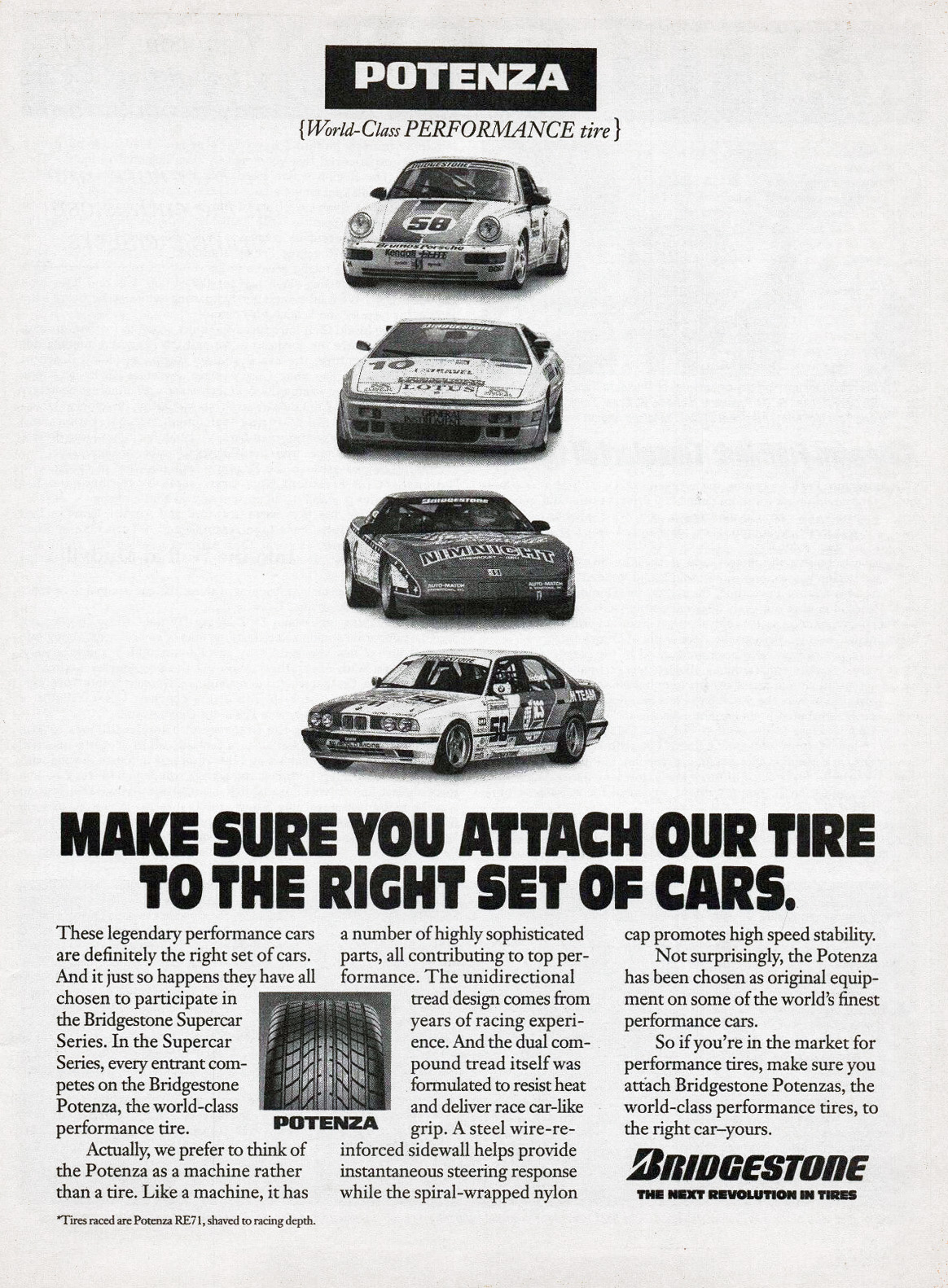
Every homologation story needs an opponent, and the X180R’s was a Porsche. When IMSA opened its Bridgestone Potenza Supercar Championship in 1991, the same twenty-car rule that forced Lotus to build twenty road-legal Esprits also compelled Stuttgart to build twenty road-legal 911s. What follows is that rivalry as it looked from the Lotus side of the paddock — how Porsche satisfied the same regulation by a very different route, and how the two programs eventually traded accusations over the very rule that had created them both.
Two answers to the same rule
IMSA’s homologation requirements were unambiguous: to campaign a car in the Bridgestone Supercar series, a manufacturer had to have built at least 200 nearly identical road cars for the US market, plus a run of at least 20 sharing the critical components of the race car, all sold road-legal in North America and landed before the season. Lotus met that rule by building twenty X180Rs that were about as close to the race car as a street registration would allow — chassis-integrated RAC-approved roll cage, adjustable racing suspension, blueprinted engine, deleted trim. Porsche, needing a comparable weapon, produced exactly twenty examples of what it called the 964 Turbo S2, matching Lotus’s count car for car.
Why not the RS N-GTPorsche already had a more obvious racing basis in the 1991 964 Carrera RS N-GT, but that car had been developed well beyond anything the company was prepared to sell for street use in the United States. The homologation rule’s insistence that the cars be capable of licensing for the road ruled it out. The Turbo, by contrast, was already a production model Porsche sold worldwide — a far safer starting point for a car that had to survive both a customer’s driveway and IMSA’s technical inspection.
A more civilized homologation specialWhere the X180R was stripped and race-ready, the 964 Turbo S2 kept its manners. Porsche delivered the cars to customers without a factory roll cage, without racing harnesses, and without a spartan interior — a fully trimmed Turbo, in other words, rather than a caged replica of the race car. The contrast is the clearest single expression of the two companies’ philosophies: Lotus erred toward building the most complete road-legal copy of its racer it could register, while Porsche offered a luxurious road car that happened to clear the same regulatory bar.
The ANDIAL import gambit
Porsche’s caution had a hard-won origin. The company still carried painful memories of its protracted fight with the DOT and EPA over importing the 959 Sport under a non-road-going race-car exemption — a fight it had lost, in a market critical to its finances. Wary of again presenting US regulators with a modified, race-tuned road car, Porsche and its American motorsport arm engineered a way around the problem.
The engine-swap routePorsche racing driver Hans Stuck and Alwin Springer — then president of Porsche Motorsports North America and owner of the ANDIAL tuning concern — devised a plan by which Porsche would build and export twenty fully-optioned, USA-specification 964 Turbos directly to ANDIAL. Critically, the cars left the Stuttgart factory with only minimal engine preparation, because the Type M30/69 3.3-liter turbocharged racing engine in full tune would not have cleared EPA import requirements. Once the homologation cars reached ANDIAL in California,
the tuner installed an already-homologated "retrofit" power kit supplied by Porsche before the cars were distributed to dealers. In effect, the car that passed federal import inspection and the car that reached the customer were not quite the same car, and both were legal.The power kit and the priceIndependent accounts of the ANDIAL upgrade describe a K27 turbocharger, a larger intercooler, revised camshaft profile, and ported-and-polished cylinder heads, for an advertised output of about 322 hp (per The Drive’s history of the model). By the time the finished cars reached their dealers — eighteen in the United States and two in Canada — the added power kit had raised the base sticker by $10,065, to $119,005, before any further options. That undercut the 1991 X180R’s $126,000 MSRP, though the comparison flatters neither: both were six-figure homologation curiosities built to satisfy a rulebook rather than a market.
A note on the count: the source material for this project records Porsche building “exactly 20” S2s and reaching customers through eighteen US dealers and two in Canada, mirroring Lotus’s twenty. Some published histories instead describe eighteen cars delivered in the US and two in Canada — twenty in total. The distinction (twenty US cars plus two Canadian, versus twenty cars split 18/2) remains unresolved here, and awaits a researcher with access to Porsche’s build records.
The “S2” on the window sticker
The gamesmanship extended to the paperwork. Because ANDIAL’s conversion touched a great deal — a different turbocharger, a different intercooler, revised camshafts, a changed cylinder-head gasket, and adjusted valve lifts, clearances, and timing — the question of whether the raced car matched the delivered car was live from the start. Porsche’s answer was to have the Monroney window sticker carry an “S2” notation, formally distinguishing the model as delivered. Technically legal under IMSA’s own rulebook, it was nonetheless pushing the boundaries: the S2 designation existed in no small part to make the ANDIAL-tuned specification the “production” car of record.
It worked. Porsche was allowed to compete with the S2 and, with Hurley Haywood and Hans Stuck leading the effort, won four of the seven races in 1991 to secure the inaugural Bridgestone Supercar Championship. Lotus, which contested only the last three rounds of that first season, took a single win. Porsche would win the title again in 1993. In between, 1992 was the X180R’s year — Doc Bundy taking the Drivers’ Championship, though Porsche edged Lotus for the Manufacturers’ title by three points, 149 to 146 — the season that crowned the car and, as it turned out, the last major racing title any Lotus model would claim.
The irony at Lime Rock
The rivalry’s sharpest turn came over the same kind of accusation Porsche’s own homologation had invited. When IMSA competitors protested in 1992 that the X180Rs on track might not match the production car, LotuSport’s Jack Ansley answered that the cars were “1992 model X180Rs,” running a different turbocharger under part number 525.4021.603AF for those later variants — the manufacturer-part-number defense that the series’ rules expressly permitted.
The irony arrived the following year. At Lime Rock on May 31, 1993, David Murry won for LotuSport, only to be disqualified after IMSA — with Porsche among the protesting parties — suspected his X180R of running the wrong turbocharger. Yet 525.4021.603AF was the correct turbocharger for the 1992-specification X180R he was campaigning. A championship built on Porsche’s own “S2” sticker and ANDIAL engine swap now saw Porsche on the other side of a turbocharger protest, disqualifying a Lotus for a part that was, by the manufacturer’s records, entirely legal. The two programs had answered the same twenty-car rule by opposite means, and in the end each accused the other of the very thing the rule had all but designed them to do.
Stuck’s pole at Del MarFor all the paperwork and protests, the on-track rivalry was genuine and close. At the Camel Grand Prix of Greater San Diego in October 1991, Lotus driver Bobby Carradine held provisional pole with five minutes left in qualifying, only to be knocked to the second row in the final minute when Hans Stuck set a series course record of 72.972 mph (117.44 km/h) in the Porsche 911 Turbo. Carradine qualified third at 72.660 mph, behind teammate Doc Bundy — the margins that separated the two cars measured in hundredths of a mile per hour. (See the reprinted Los Angeles Times account at /racing/1991/#la-times-1991.)
Where the Porsche story is told in full
This chapter is deliberately the view from the Lotus garage — the rival as the X180R’s people encountered it, protested against, and were protested by. It is not the definitive account of the 964 Turbo S2 itself: its development at Weissach, ANDIAL’s engineering, the Brumos campaign, and the drivers who carried it to two championships all deserve fuller treatment than a rivalry chapter can give. That treatment exists. The definitive Porsche-side history of the 964 Turbo S2 and its Supercar campaign is a dedicated chapter by Christoph Maeder in the forthcoming book, and readers wanting the Stuttgart perspective in depth should look there.
For the verified facts and figures on the rival itself — its numbers, the ANDIAL import scheme, and its two championships — see its own page: the Porsche 964 Turbo S2. For a broader survey of the era’s comparable homologation specials — the 964 Carrera Cup, the Japan-market 964 RS N-GT Clubsport, the Ferrari 348 GT Competizione and 355 Challenge among them — see the References page’s “Similar Contemporary Cars.”
If the Porsche was the rival Lotus built the X180R to beat, there remained one market where the X180R was pitched and never sold, and one softer successor that carried its spirit to Le Mans. That is the road not taken — Europe and the Sport 300.