Part One Origins & Construction
Imagine walking into a Chevrolet dealer and driving away in a new, factory-built Corvette C8.R — caged, race-ready, and licensed for the public road. No manufacturer offers such a car today, at any price. Thirty years ago, for a brief window, one did: the Lotus Esprit X180R. This is the story of how it came to exist, the people who built and raced it, and the twenty road cars and five factory racers that survive as the record of it.
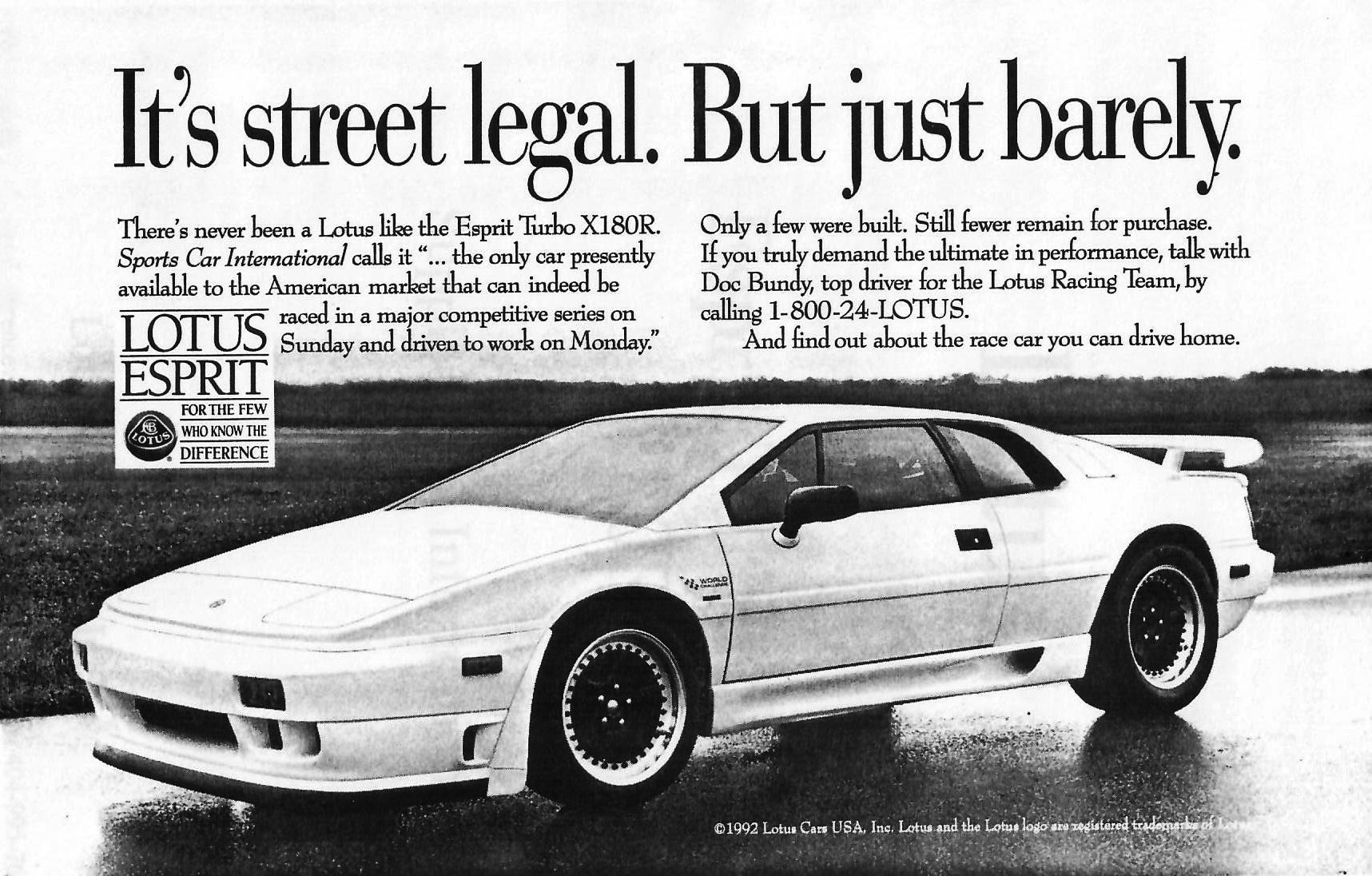
A race car you could registerOnly twenty road-legal homologation cars were built, alongside five SCCA/IMSA factory-prepared racers, and no other Esprit was remotely like them. Straight from Hethel, the X180R was a highly developed race car for the road: a chassis-integrated roll cage, fully adjustable racing suspension, a blueprinted engine, specialized and deleted parts for meaningful weight savings, and a catalog of competition upgrades. Seen from three decades on, it stands as the last factory-built race car with a full roll cage — from any manufacturer — sold new in the United States and capable of being licensed for the street.
The bound is deliberate, because one car came close. The 1995-model-year Ferrari F355 Challenge was a street 355 that an authorized dealer converted into a racer using a roughly US$30,000 kit supplied by the factory (roll cage, harnesses, competition brakes and wheels, fire extinguisher, cut-off switch, and the rest); the earliest cars were dealer-built before Maranello later assembled them in-house. That is a factory-kitted, dealer-built conversion — not, as the X180R was, a complete car that left the manufacturer’s own line caged and ready to race yet still eligible for a license plate. It is a narrow distinction, but the whole character of the X180R lives inside it.
Three cars, one bloodlineThe factory built the race-ready Esprit in three distinct variations, and keeping them straight is the key to everything that follows.
First came the Type 105, the World Challenge race car, created when Lotus pulled two production Esprit SEs off the line and converted them for the SCCA’s newly opened professional series. Their success on track in 1990 set the stage for what came next. This is the subject of Origins: World Challenge and the Type 105.
Next came the X180R homologation car — the twenty North American “race replica” road cars Lotus built to qualify the Esprit for IMSA’s new Bridgestone Potenza Supercar Championship. Standard Esprits satisfied the series’ other production minimums; the twenty caged cars satisfied the rest. For marketing, Lotus leaned on the prior year’s World Challenge title, branded the model the “World Challenge” edition, and applied the World Challenge flag logo to the front fenders. Why exactly twenty, why only in North America, and why all at once against a looming tax deadline are questions answered in Homologating the X180R: Why Exactly Twenty and Building the Car at Hethel.
The final variation was the Type 106, the fully developed IMSA Supercar racer — built new and, together with the two upgraded Type 105s, bringing the factory race fleet to five. Because IMSA’s rules demanded minimal deviation from the road car, the Type 106 was based on the X180R homologation car rather than developed freely. Its wars with Porsche are told in The IMSA Supercar Wars: Type 106, 1991–1995.
A championship, then the weightIn its first full Bridgestone Supercar season, the X180R took the drivers’ title against Porsche’s determined effort to repeat its inaugural-season victory — and lost the manufacturers’ championship to that same Porsche effort by three points, 149 to 146. IMSA then added substantial weight penalties, race after race, to slow the Lotus down.
Because the series was built to normalize performance and keep the field close, the X180R stayed competitive — many poles, many wins — but further overall championships proved elusive. That rivalry, from the Lotus perspective, is the subject of The Rival: Porsche 964 Turbo S2; the road not taken in Europe and the more road-focused successor are covered in Europe and the Sport 300.
What this isWhat follows is a primary-sourced history assembled from the recollections of the engineers, team owners, and drivers who were there, from factory documents and period reporting, and from the cars themselves. Where the record is firm, it is stated plainly; where it is silent or contested, that is said openly rather than smoothed over. The dispersal of the fleet and its vintage revival are traced in Aftermath: Dispersal, Vintage Revival, and Goodwood; the individuals who made it happen are gathered in The People; and the surviving cars are cataloged in the Registry. Corrections and new material are welcome — the record is a living, shared document.